


A New England car detailing business struggled with low visibility on Google Maps and almost no website traffic despite years of solid service. After a full car detailing SEO New England strategy covering technical fixes, citations and Google Business Profile optimization, the business reached 309 profile interactions and 7 qualified leads within 90 days.
Result Snapshot
| Metric | Result Achieved |
|---|---|
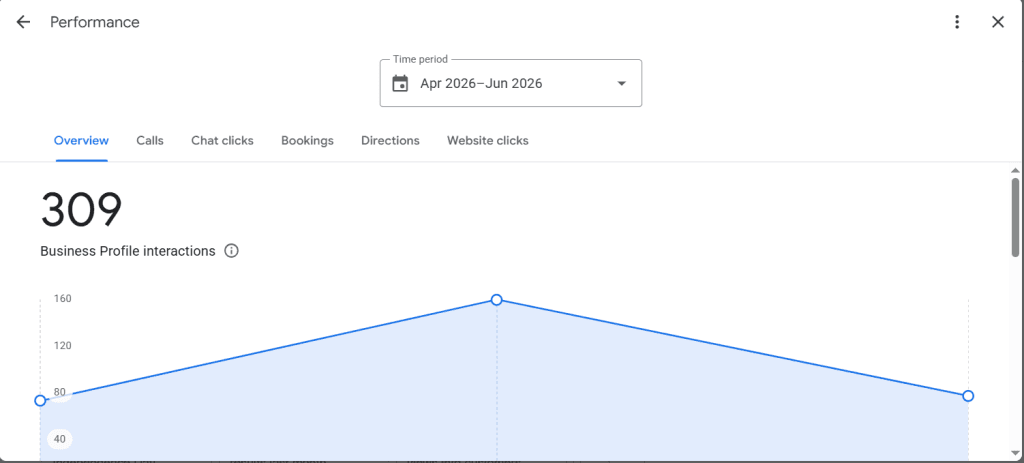
| Google Business Profile interactions (Apr to Jun 2026) | 309 total interactions |
| Peak monthly GBP interactions | 160 interactions in May 2026, up from around 60 in April |
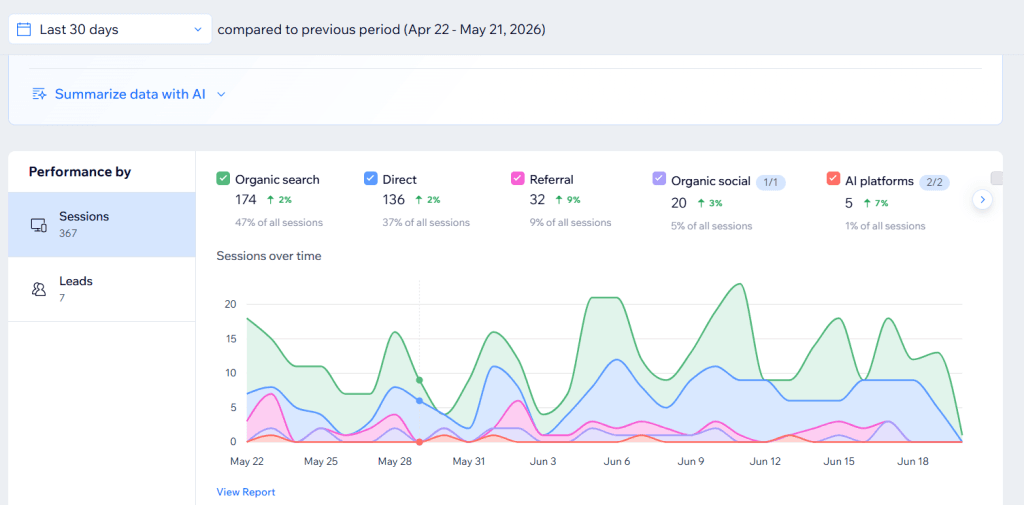
| Website sessions (May 22 to Jun 20, 30 day window) | 367 total sessions |
| Qualified leads generated directly from the website | 7 leads |
| Organic search traffic share | 174 sessions, 47% of all traffic, up 2% period over period |
| Referral traffic growth | 32 sessions, up 9% |
| Organic social traffic growth | 20 sessions, up 3% |
| AI platform sessions, direct AEO proof | 5 sessions, up 7% |
About the Client
The business is an independently owned car detailing company operating across New England, serving a mix of residential customers booking interior and exterior detailing packages and a smaller base of repeat clients who use the service for vehicle prep before resale or trade in. The team is small, hands on, and the owner handles much of the day to day work themselves, which is common across the local car detailing SEO New England space where most competitors are single location operators rather than franchises. Before this project, the business relied almost entirely on word of mouth and a handful of repeat customers. There was no consistent system for turning local search visibility into booked jobs, and the website existed mostly as a digital business card rather than a lead generation tool.
The Problem
The business was barely visible on Google Maps for the services it actually offered. Searches for car detailing near specific New England towns returned competitors who were objectively offering less, but ranking higher. The Google Business Profile had almost no monthly activity, the website on Wix was indexed inconsistently, and there was no local citation presence strong enough to signal trust to Google. The real cost was not abstract. Every week the business stayed invisible in the Map Pack was a week of detailing jobs going to a competitor down the road who simply showed up first. For a service business that depends on being seen at the exact moment someone searches “car detailing near me,” this is not a minor inconvenience, it is lost revenue that never gets recovered.
Root Cause Analysis
A full audit traced the visibility problem to four separate but connected issues. First, the Wix site had indexing gaps. Several service pages were either not submitted properly to Google or were being crawled inconsistently, which meant the content existed but Google was not confident enough in it to rank it. Second, the site had no structured data. Without Local Business and Service schema, Google and AI search engines had no machine readable way to understand exactly what the business did, where it operated, and what services it offered, which directly limited how the content could be surfaced in AI Overviews or chatbot answers. Third, the citation profile was inconsistent. Older directory listings had different versions of the business name, address and phone number, a classic NAP inconsistency problem that actively confuses Google’s local algorithm about which version of the business is correct, which suppresses Map Pack ranking even when everything else is solid. Fourth, the Google Business Profile itself was under optimized, using a generic primary category and no secondary categories, which meant the profile was competing for broad terms instead of the specific detailing services that actually convert.
The Strategy
The approach was to fix the foundation before touching anything else. Content and citations do not help a business that Google cannot properly crawl, trust or categorize, so technical SEO and schema implementation came first, immediately followed by cleaning the existing citation mess rather than building new citations on top of a broken NAP profile. Building new citations before resolving NAP inconsistency would have made the inconsistency worse, not better, so the toxic listings were corrected first. Mass, cheap citation services were intentionally avoided in favor of a manual, top tier citation campaign targeting high authority local and auto industry specific directories, since a smaller number of trusted citations carries more local SEO weight than a large number of low quality ones. Geo-grid tracking was built into the plan from week one rather than added later, because guessing whether rankings are improving across an entire region like New England is not reliable. Actual neighborhood level visibility data was needed to confirm the work was moving the needle in the specific towns where the business operates.
The Execution
Weeks 1 to 2: Audit and Competitor Strategy
The project opened with a deep Semrush based competitor analysis, dissecting the top three ranking local car detailing competitors across New England to identify keyword gaps and local search intent the business was missing entirely. This research was compiled into a 30 page core strategy document that became the reference point for every decision made afterward, rather than working from assumptions.
Weeks 3 to 4: Technical and On-Page SEO on Wix
This phase involved fixing Wix specific indexing configurations and cleaning up URL structures so Google could properly crawl every service page. Local Business and Service schema was injected across the site, which later proved to be the direct reason AI platforms started sending traffic. On the content side, meta tags, H1 and H2 headers, and the localized service content itself were rewritten to align with the keyword gaps surfaced in the Semrush research, focusing on the specific detailing services customers were actually searching for rather than generic descriptions. One piece of friction here is worth being honest about. Wix does not always reflect technical changes quickly, and pushing updates through required manual indexing efforts rather than the immediate recognition you would get on some other platforms.
Weeks 5 to 6: Off-Page SEO and Citation Cleanup
A full citation audit was run using BrightLocal, which surfaced a messy spread of older directory listings with inconsistent NAP details. These toxic inconsistencies were the single biggest piece of friction in the entire project, since they were actively working against the Map Pack rankings the business needed and creating confusion for search engines trying to verify which version of the business profile was accurate. Once cleaned, a targeted, manual top tier citation campaign placed the business in high authority local and auto industry specific directories, the kind that actually move trust signals rather than padding a citation count.
Weeks 7 onward: GBP Overhaul and Geo-Grid Tracking
The Google Business Profile was rebuilt from the category level up, refining the primary category and adding competitor researched secondary categories that better matched what customers were actually searching for. Geo-optimized images of the detailing work itself were uploaded to strengthen relevance signals. Local Dominator was used to run geo-grid searches across the New England service area, tracking neighborhood level visibility in the Map Pack and allowing local signals to be adjusted based on real grid data rather than guesswork. The payoff became visible once the top tier citations finished indexing and synced with the optimized on-page elements on Wix. That alignment is what produced the 160 interaction spike on the Google Business Profile in May.
The Results
April reflected the slow, foundational part of the work, with Business Profile interactions sitting around 60 as the technical fixes and early citation cleanup were still being indexed by Google. May is where the compounding effect showed up clearly, with interactions jumping to 160 once the top tier citations had fully indexed and synced with the schema and on-page changes from Wix. Across the full three month window from April to June, the profile generated 309 total interactions. On the website side, the most recent 30 day window shows 367 sessions, with organic search as the clear leader at 174 sessions, 47% of all traffic, and a 2% upward trend. Those sessions converted into 7 qualified leads directly from the site, a meaningful number for a small, locally focused detailing business. Referral traffic grew 9% to 32 sessions and organic social grew 3% to 20 sessions, both signs the local presence is becoming well rounded rather than dependent on a single channel. The smallest number on the dashboard, 5 sessions from AI platforms, is also the most strategically significant. It is direct, measurable proof that the Local Business and Service schema implemented in weeks 3 to 4 is being picked up and surfaced by AI Overviews and chatbot style search, a channel that barely existed for this business before the project started. It is still a small absolute number, and it would be dishonest to oversell it, but a 7% increase from a standing start is exactly the trend you want to see this early in an AEO strategy.
Ready to See Similar Results for Your Detailing Business?
If your car detailing business is struggling to show up on Google Maps or AI search results across New England, this is the exact process that worked. Book a free video meeting or message on WhatsApp to talk through what’s holding your visibility back.