


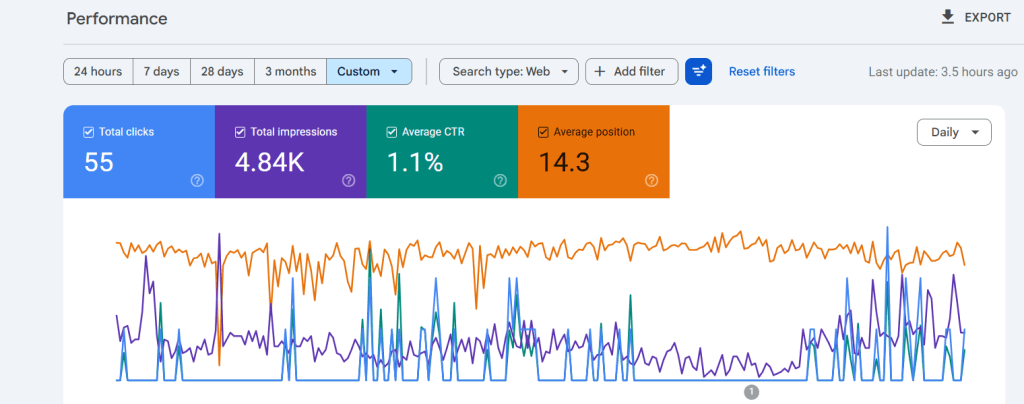
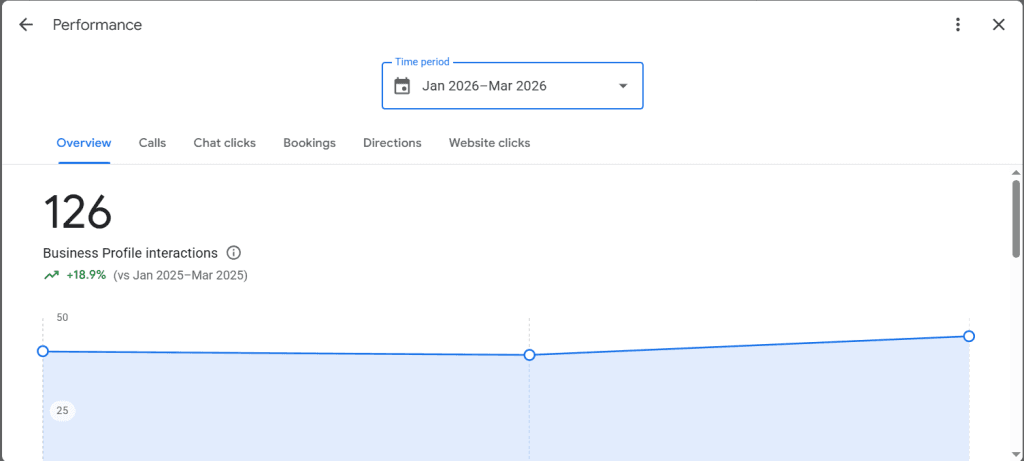
A Prague-based tour guide business had no website and an underoptimized Google Business Profile entering 2026. Through a full WordPress build with Rank Math SEO, precise GBP activity field optimization and targeted citation building via BrightLocal, local SEO for tour guides in Prague delivered 4,840 impressions, 55 organic clicks and 18.9% more profile interactions in 90 days.
Result Snapshot
| Metric | Result Achieved |
|---|---|
| GBP Interactions (Q1 2026) | 126 total interactions across 90 days |
| GBP Year-over-Year Growth | +18.9% vs Q1 2025 |
| Organic Search Impressions | 4,840 impressions from a brand-new website |
| Organic Clicks | 55 clicks within the first quarter of launch |
| Average Search Position | 14.3 across all tracked queries |
| Average CTR | 1.1% across all tracked impressions |
| Website Status at Start | No website existed |
| Project Timeline | January 2026 to March 2026 |
About the Client: A Small Independent Tour Guide Competing in One of Europe’s Most Visited Cities
Prague draws over 7 million international tourists each year. For a small independent tour guide business to build meaningful digital presence in that market, it needs to compete against review aggregators, large booking platforms and established local operators who have been indexed and accumulating authority for years.
This client fits that profile exactly. A small, independently operated tour guide business based in Prague, Czech Republic, offering specialized walking tours and local experiences with a strong focus on English-speaking international visitors travelling from the UK, USA and broader Europe. The business had been operating for a period before this project began and had a genuine product: knowledgeable, personalized guided experiences that stood apart from the group tour model. The problem was not the quality of the service. The problem was digital visibility, the absence of it.
Despite the volume of tourists actively searching for Prague tour experiences every month, this business could not be found through Google Search at the planning phase and was pulling minimal engagement through Google Maps. No website meant no organic presence. A GBP that had never been properly configured meant Maps visibility was far below what the profile could support. Both channels needed to be built or rebuilt from the ground up, simultaneously, without the luxury of optimizing one and waiting for results before touching the other.
The Problem: A Quality Tour Business Invisible to the Tourists Already Looking for It
Every week without a functional website and a properly optimized GBP was a week of missed bookings from tourists who had already decided they wanted a Prague tour. They were searching. They were clicking results. The bookings were going to whoever appeared in the results, and this business was not appearing.
The specific consequences were measurable even before the project started. GBP interactions existed, meaning some people were finding the listing, but interaction volume was low and not growing at a pace that reflected the demand for Prague tourism content. Without a website linked to the GBP, visitors who clicked through to learn more hit a dead end. No service pages. No testimonials. No tour descriptions to read. No contact form to submit. The booking journey stopped before it started.
The second consequence was that the business had no ability to capture search traffic from tourists who were still in the planning phase, the research-and-compare stage that happens weeks or months before travel. That traffic, which represents the highest volume of travel-intent searches, was going entirely to aggregator platforms and competing operators who had invested in their web presence. Those are bookings that should have been winnable.
Root Cause Analysis: Why Solid Tour Businesses Disappear in Competitive Travel Markets
An Unoptimized GBP Costs a Tour Guide More Than Most Owners Realize
The starting Google Business Profile had basic information present but was missing the structured detail that Google’s local algorithm actually uses to rank businesses in Maps results. For tour guide businesses specifically, GBP includes a dedicated section for listing activities and experiences. These fields allow a guide to describe individual tours by name, duration, language, group size and price in a format Google can read and surface directly in Knowledge Panels and Maps listings.
Every one of those fields was empty.
Google’s local ranking system weighs relevance heavily. When someone searches “Prague walking tour” or “historical tour guide Prague”, Google is not simply matching text. It is comparing how completely each business in its index has described what it offers, in the specific structured format Google has built for that category. A profile that leaves its activity fields blank competes against profiles that have given Google a detailed, structured picture of every tour, language and experience type available. The outcome of that mismatch is lower Maps ranking, fewer impressions and fewer clicks, regardless of how good the actual tours are.
No Website Means No Presence at the Stage Where Most Bookings Begin
The absence of a website created a structural problem that went beyond GBP performance. Without a website, there was no asset for Google to index and associate with the business. GBP can generate call clicks and direction requests from people who are already in Prague or are close to booking. It cannot capture the planning-phase search, the stage where tourists are choosing destinations, reading about neighborhoods, comparing tour styles and deciding which operators look trustworthy enough to book.
Those planning-phase searches land on websites, not Maps profiles. And in Prague tourism search, the websites that dominate that traffic are aggregators: TripAdvisor, Viator, GetYourGuide. These platforms have domain authority built over more than a decade of content, links and traffic data. A new independent website cannot beat them on authority in 90 days. What a new website can do, if built with the right structure and targeting the right queries, is compete in the specific niches that aggregators serve poorly. Their listing pages rank broadly but weakly for specific, hyper-local queries. “Prague Jewish Quarter private tour in English” or “small group Prague walking tour off the tourist trail” are exactly the type of queries where an independent operator with a well-structured service page can outperform a generic aggregator listing.
No website meant none of those gaps were being captured at all.
Citation Gaps Weakened the Signals Google Needed to Trust the Business
Local citation profiles tell Google three things: that a business is real, where it operates and what it does. For a Prague tour guide business with no citation presence across tourism and general directories, Google had very little third-party verification to work with. That absence of third-party signals reduces confidence in the GBP listing and contributes to lower local pack rankings in competitive markets.
The Strategy: Build the Foundation Correctly Before Expecting Rankings
The decision made at the start of this project was to build both digital assets simultaneously rather than sequence them. Optimize the GBP first and wait for gains before building the website was the alternative approach. That approach was rejected because the two channels serve different audiences and different stages of the customer journey. Waiting on the website meant losing months of planning-phase traffic that the business had no way to recover.
The GBP overhaul needed to happen immediately because Google can reweight a profile within days to weeks of meaningful changes. Rankings respond to GBP updates faster than they respond to new website content, which requires indexing time, behavioral signals and authority accumulation. Getting the GBP optimized in week one meant the profile could be generating improved Maps results while the website was still being built.
The website strategy centered on getting the architecture right before writing a single word of content. Page structure, URL format, internal linking hierarchy and schema implementation were planned before anything was published. A well-structured site indexed cleanly from the start compounds faster than a site that launches messy and is patched later.
Citation building was the third layer, planned to begin after the website was live and indexed so that every citation pointing back to the site could contribute to a clean, consistent signal rather than pointing to a URL that did not yet exist.
The Execution: How a Full Digital Presence Was Built for a Prague Tour Guide in 13 Weeks
Phase 1 (Weeks 1 to 2): GBP Rebuild and Site Architecture Planning
The first week focused on the GBP overhaul and pre-build planning for the website. Launching into content production without planning page structure is one of the most common mistakes in local SEO website builds. It results in siloed pages, poor internal linking and URL structures that have to be changed later at the cost of rankings already earned.
The site architecture was mapped to reflect the actual search behavior of two distinct audiences: international tourists doing pre-trip research, and tourists already in Prague searching for experiences to book that day or week. Those two audiences search differently, click differently and need different content. Service pages covering specific tour types were the core. Informational content targeting planning-phase queries was built around them.
The GBP overhaul ran in parallel. The activity and experience section was filled in completely for every tour type offered, staying within Google’s character limits for each field and using language that matched the terminology tourists actually use in search rather than the internal language the business used to describe its tours. Every available GBP field was reviewed and completed: primary and secondary categories, services, business description, business hours, attributes and the Q&A section. The before state was a partial listing. The after state was a complete, structured profile that gave Google everything it needed to understand the business and rank it accurately.
Phase 2 (Weeks 2 to 5): WordPress Build with Rank Math, Schema and Lead Capture
The website was built on WordPress with Rank Math SEO installed and configured before the first page was published. The choice of Rank Math over alternatives for this project came down to its schema implementation. For a tourism business, LocalBusiness and TouristAttraction schema needed to be set up correctly from day one. Rank Math handles these schema types cleanly through its interface without requiring manual JSON-LD injection for the standard fields.
On-page elements were set before each page went live: meta title, meta description, header hierarchy from H1 through H3, image alt text, internal links to and from every page, canonical tags and Open Graph data for social sharing. Nothing was left to be fixed after launch.
Contact Form 7 was installed and connected to Flamingo for lead management. This was not a nice to have. International tourists booking tours weeks or months in advance often send inquiry messages before committing to a booking. If a form submission arrived and went unanswered because no notification was set up correctly, that booking was gone. Flamingo stores every submission in the WordPress database as a permanent record, making it easy to review and follow up without depending on email notifications alone.
The content writing phase carried a specific challenge. Every page had to work for two audiences simultaneously: the international tourist who needed to feel the experience before clicking Book, and Google’s crawler, which needed specific location signals, service descriptions and keyword context. Writing pages that serve both without sounding like they were written for either was the editorial constraint that shaped every piece of content. Pages that leaned too hard into keyword density sounded robotic and would not convert. Pages written purely for the tourist experience would not rank. Every page required judgment on where location signals and keyword uses genuinely fit the narrative.
Phase 3 (Weeks 5 to 10): Citation Building Across General and Tourism Directories
With the website indexed and the GBP live with complete optimization, citation building began using BrightLocal. The Prague tourism context shaped the citation strategy. General directory citations establish NAP consistency. Tourism-specific directory citations build relevance signals Google associates specifically with travel and hospitality businesses. Both types were necessary and both were built in parallel.
An unexpected delay came up during this phase. Two tourism-specific directories required verified business documentation before accepting a listing submission. The verification process for both took longer than the standard directory submission timeline, adding more than a week of delay to those specific submissions. Rather than pausing citation building to wait, every available directory that did not require prior verification was processed first. The delayed directories were submitted the day documentation was confirmed. By week 10, the citation profile was clean, consistent across all directories and representative of the tourism category positioning the GBP and website were targeting.
NAP consistency across all citations was checked manually before each submission was finalized. A single variation in address format or phone number format creates conflicting signals that dilute the trust benefit citations are supposed to provide. Every listing was verified against the same master NAP data before submission.
Phase 4 (Weeks 10 to 13): Content Expansion, CTR Optimization and Position Monitoring
The final weeks of Q1 focused on expanding content beyond core service pages. Informational content targeting planning-phase queries, Prague day trip options, neighborhood guides and experience type comparisons, was added to increase the number of indexed pages Google could rank for research-intent searches.
Google Search Console data was reviewed weekly. The focus was on queries generating impressions without clicks, which typically indicates that the page is ranking at a position where it is being seen but the title or meta description is not compelling enough to earn the click. Several title tags were rewritten based on this data to better match the intent behind the search and improve CTR at positions where rankings had already been secured.
Position tracking through Rank Math was cross-referenced with Search Console position data to ensure consistency and catch any indexing or ranking anomalies early. No major technical issues emerged post-launch, which is a direct result of getting the technical foundation right before the first page was published.
The Results: What 90 Days of Structured Local SEO Work Produced for a Prague Tour Guide
By the close of March 2026, the Google Business Profile was generating 126 interactions in the quarter, a year-over-year increase of 18.9% against Q1 2025. These interactions came from a listing that technically existed twelve months prior but had never been properly configured. No paid promotion was used to generate that lift. The growth came entirely from completing the activity fields, filling in every available GBP field with accurate structured data and improving the profile’s relevance signals in the category Google uses for tour businesses.
The website, which did not exist before January 2026, generated 4,840 impressions in Google Search within its first quarter of being indexed. For a brand-new WordPress site competing in one of the most heavily contested tourism markets in Europe, 4,840 impressions in 90 days reflects both the speed at which a technically clean site gets indexed and the effectiveness of targeting specific query gaps that aggregator sites do not serve well.
The 55 organic clicks at an average position of 14.3 and a 1.1% CTR are a realistic picture of where a new site sits at the end of its first quarter. Position 14 means the site is ranking on the boundary between page one and page two for most queries. Clicks at that position are limited but present. The site was already competing in Prague tourism SERPs against pages with years of indexed history. Those early rankings provide the behavioral signal foundation that allows positions to improve in the months that follow. The CTR of 1.1% at that position range is within the expected band and will improve as positions move upward and title tags are refined based on Search Console impression data.
The GBP interaction improvement happened faster than the organic search growth, which is consistent with how local SEO behaves in practice. A fully optimized GBP responds to changes within weeks. A new website takes months to build the behavioral and authority signals that push rankings from page two to page one. Both channels are moving in the right direction. The compounding effect of a fully optimized GBP and a growing organic search presence builds meaningfully in Q2 and beyond.
Ready to Build Visibility for Your Tour Guide or Tourism Business?
If you operate a tour guide business in Prague, anywhere in Europe or internationally, and your digital presence does not reflect the quality of what you deliver, this kind of work is repeatable. Book a free video call or send a message on WhatsApp to talk through where you are starting from and what the right strategy looks like for your market.