


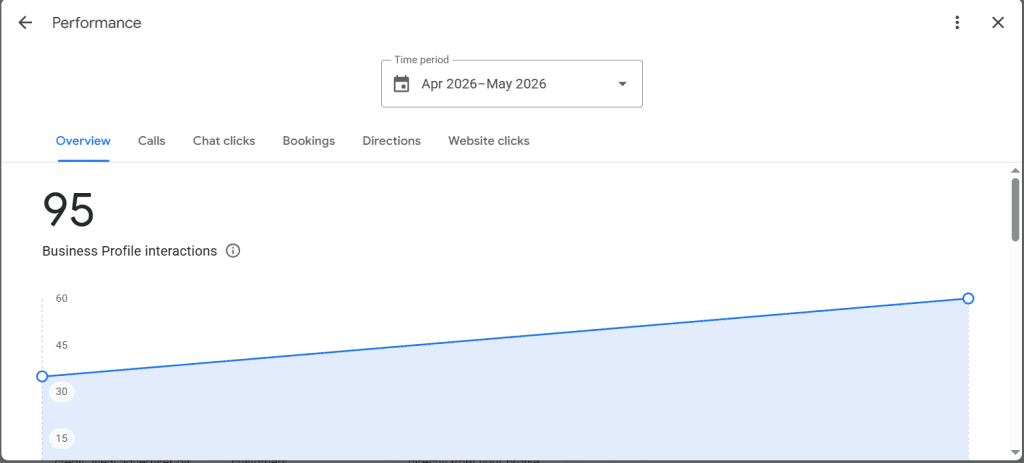
A home care service area business in Arizona was generating almost no local visibility through Google despite operating in a high-demand niche. With no storefront and no website driving SEO authority, this GBP optimization project focused entirely on local map pack dominance. Within two months, the profile went from roughly 35 monthly interactions to a peak of 60 in a single month, totaling 95 verified Business Profile interactions across April and May 2026.
Result Snapshot
| Metric | Result Achieved |
|---|---|
| Total GBP Interactions (2 months) | 95 verified interactions |
| Interactions at Project Start (early April) | ~35 per month |
| Interactions at Peak (end of May) | 60 in a single month |
| Growth Pattern | Continuous uninterrupted upward trend across 8 weeks |
| Traffic Source | 100% from local map pack and local search intent |
| Website Dependency | Zero – GBP standalone strategy only |
| Citation Campaign | Top-tier healthcare and local community directories via BrightLocal |
| Geo-Grid Baseline Tool | Local Falcon |
About the Client: A Home Care Provider Serving Multiple Areas Across Arizona
This client operates a home care business in Arizona, providing in-home personal care and support services directly to clients at their residences. They are a small local team serving multiple zip codes and counties across their designated service area, with no physical storefront that customers visit. Their customer base consists primarily of elderly individuals, people with disabilities and families seeking consistent in-home care support.
Because they operate as a Service Area Business, or SAB, the standard rules of local SEO apply differently to them compared to a business with a fixed address. There is no walk-in traffic signal, no physical location anchor for Google to use in the traditional sense, and no website with domain authority reinforcing their presence. Everything in this project had to be built on GBP optimization for home care search intent in Arizona, using profile signals, structured service data and citation authority as the foundation.
The Problem: A Home Care Business That Google Could Not Properly Locate or Rank
When the project began in April 2026, the business had a Google Business Profile that existed but was doing almost no visible work in the local map pack. Interactions were low and inconsistent, hovering around 35 per month, which meant potential clients searching for home care services in their area were finding competitors instead.
For a home care provider, losing that visibility is not a minor inconvenience. Home care is a high-intent search category. When someone searches for in-home care services in Arizona, they are usually looking urgently, either for themselves or for a family member. A business that does not appear in the map pack during those searches does not get a second chance. The lead goes elsewhere, often permanently.
What made this more damaging was that the business had no website to compensate for the weak GBP. Many local businesses with poor map pack rankings can at least capture some organic traffic through their site. This business had neither channel performing. The result was a profile that existed without producing any measurable business outcome from local search.
Root Cause Analysis: Why the Profile Was Failing to Show Up
The profile had several compounding problems that were preventing it from ranking in the Arizona home care local map pack.
The first issue was category misconfiguration. The primary category on the profile was not tightly matched to the specific home care service type they offered. Google uses the primary category as one of its strongest signals for determining what searches a business should appear in. A vague or slightly mismatched category means the profile competes in a broader pool and ranks lower across the board, rather than performing well in the specific high-intent searches that actually convert.
The second issue was service area definition. For a Service Area Business, how you define your coverage area inside the GBP settings matters significantly. The profile had service areas set in a way that did not account for competitor density or geographic proximity logic. Google uses distance from the searcher as a major ranking factor in the local map pack. If the defined service area does not align with the areas where real search demand exists, the profile loses visibility in exactly the neighborhoods where the business wants to appear. Setting service areas too broadly also dilutes the relevance signal, making the profile less competitive everywhere rather than dominant somewhere.
The third issue was citation inconsistency. The business had existing mentions scattered across various online directories, but the NAP data, meaning the business name, address and phone number, was not consistent across these sources. For a Service Area Business that does not display a physical address publicly, citation consistency becomes even more important because citations serve as a substitute trust signal in place of the physical location data that brick-and-mortar businesses use. Inconsistent citations introduce conflicting signals into Google’s local ranking algorithm, which weakens the profile’s authority regardless of how well the profile itself is optimized.
The fourth issue was the absence of structured service data inside the profile. The Services section was either empty or populated with minimal generic text, which meant the profile was not matching against the full range of search queries that real home care clients in Arizona were typing.
Each of these issues on its own would have caused a measurable drop in local visibility. Together, they explained why a legitimate, operating business was generating only 35 interactions per month despite serving a high-demand niche.
The Strategy: Map Pack Authority Built Entirely on GBP and Citation Signals
The strategic decision at the outset was to treat this as a GBP-first, citation-supported project with no dependency on website authority. Some local SEO strategies lean heavily on building out a website with location pages, service content and schema markup to drive rankings. For this client, that was not the right path for two reasons.
First, a website buildout takes time to gain traction. New domains typically need three to six months before organic content begins contributing meaningfully to local rankings. This client needed faster, measurable progress. Second, many service area businesses in the home care niche in Arizona rank competitively in the local map pack with lean or no websites, which meant the ceiling for GBP-only optimization had not been hit in this market.
The plan was to clean up every signal Google uses to evaluate a Service Area Business profile, build a targeted citation foundation across relevant healthcare and community directories, and monitor geo-grid performance at the neighborhood level using Local Falcon to confirm where visibility was improving and where it was not.
Alternative approaches considered included running Google Local Services Ads alongside organic optimization, but the client’s priority at this stage was building sustainable organic visibility rather than paid placement. That option remains available as a future layer if the monthly interaction volume plateaus.
The Execution: Eight Weeks of Structured GBP and Citation Work
Phase 1: Profile Audit and Structural Rebuild (Week 1)
The first week was spent auditing every element of the existing profile and establishing the geo-grid baseline using Local Falcon. The scan covered the client’s primary target neighborhoods across their Arizona service area and revealed specific zones where the map pin was losing ground to competitors. This data became the reference point for measuring improvement in later weeks.
Profile restructuring began immediately:
- The primary category was changed to precisely match the client’s core home care service type, replacing the previous broad category that had been diluting search relevance.
- The service area settings were rebuilt from scratch, mapping specific zip codes and counties based on competitor density data and search demand rather than rough geographic boundaries.
- The Services section was populated with detailed, localized descriptions for each specific service offered, written to match the language real Arizona home care searchers use.
- The business description was rewritten to include natural references to the services provided and the areas served, without keyword stuffing or language that reads like it was optimized rather than written.
Phase 2: Citation Cleanup and Authority Building (Weeks 2 to 5)
This phase addressed the citation inconsistency problem and built new directory presence through BrightLocal.
The legacy citation cleanup was the most time-consuming part of the entire project. Existing listings across various lower-quality and mismatched directories contained variations in the business name, outdated phone numbers and in some cases incorrect service descriptions. Each of these had to be corrected or suppressed. This process cannot be rushed because directory platforms have their own update cycles and some corrections take one to three weeks to propagate and be re-indexed by Google.
The new citation campaign focused strictly on:
- Top-tier national healthcare directories relevant to home care and personal care services.
- Local Arizona community directories and regional business listings with genuine domain authority.
- Niche-specific platforms where home care businesses are expected to have a presence based on competitor analysis.
No volume-based, low-quality citation services were used. The goal was a smaller number of high-relevance, high-authority citations rather than a large volume of directory placements with no topical connection to the home care industry.
Phase 3: Monitoring and Ongoing Profile Signals (Weeks 6 to 8)
Once the citation campaign was submitted and initial indexing began, the focus shifted to profile signal maintenance and performance monitoring.
Local Falcon geo-grid scans were run at regular intervals to track changes in map pack position across different zones. The data confirmed that visibility was improving steadily in the core service areas and beginning to extend into adjacent neighborhoods as the citation authority accumulated.
GBP interaction data from the dashboard was tracked weekly. The pattern that emerged was consistent with citation indexing behavior: growth was gradual in the first few weeks as directories updated, then accelerated through May as the new NAP signals consolidated and the restructured profile began matching against a broader set of relevant local searches.
One complication that appeared mid-project was a handful of legacy citations on platforms that do not allow direct owner corrections and require manual suppression requests. These took additional time to resolve and temporarily slowed the citation consolidation. The impact was absorbed in the timeline and did not prevent the overall upward trend from developing.
The Results: Consistent Growth Across Both Months With No Plateau
By the end of May 2026, the business had accumulated 95 verified GBP interactions across the two-month tracking window, with all interactions originating entirely from local map pack visibility and local search intent. There was no website, no paid advertising and no other traffic channel contributing to these numbers.
The trajectory was the most meaningful aspect of the result. The interaction chart did not show a spike followed by a drop, which would suggest a one-time trigger like a review push or a temporary ranking fluctuation. It showed a continuous, uninterrupted upward line from approximately 35 interactions in early April to 60 interactions at the peak in late May. That pattern reflects a profile that stabilized in the map pack and continued gaining ground as citation authority compounded.
For a home care business in Arizona operating with no website and no paid campaigns, 95 monthly interactions generated purely through local search is a genuine baseline of organic demand. The more significant outcome is the shape of the growth curve, which indicates the profile has reached a stable ranking position in the map pack rather than a temporary visibility window.
The areas that still have room for development are the adjacent towns beyond the core service area, where ranking as an SAB without a physical location is inherently more difficult. This was anticipated from the geo-grid data at project start and represents the next phase of work rather than a limitation of what was achieved.
If you run a home care business in Arizona and your GBP profile is not generating consistent interactions from local search, book a free video call or send a message on WhatsApp. The starting point is always a clear picture of where your profile stands and what is specifically holding it back.