
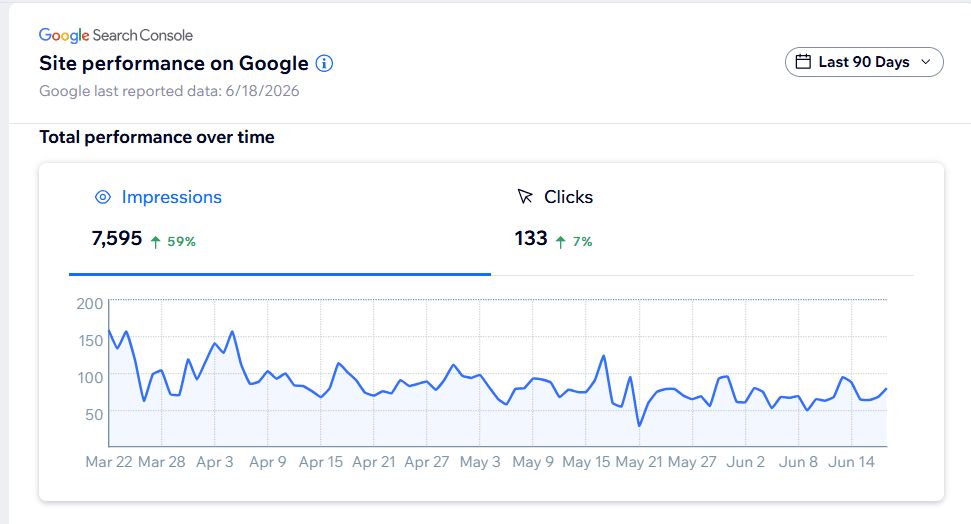
A premium boat party and private event rental business operating on the River Thames in London was generating organic impressions but failing to capture the specific, high-intent event searches that drive real bookings. A 90-day on-page SEO campaign focused entirely on intent-based service page architecture grew total impressions by 59% to 7,595 and delivered 133 organic clicks in one of the UK’s most competitive event rental markets, with zero paid traffic and no direct access to the Google Business Profile.
Result Snapshot
| Metric | Result Achieved |
|---|---|
| Campaign Duration | 90 days (March 2026 to June 2026) |
| Total Impressions (90 days) | 7,595 |
| Impression Growth | 59% increase |
| Organic Clicks | 133 |
| Click Growth Trend | 7% upward |
| Traffic Source | 100% organic search |
| Paid Advertising Used | None |
| GBP Direct Access | None – consulting and action plan only |
| Data Source | Google Search Console (last reported 18 June 2026) |
| Primary Strategy | Intent-mapped dedicated service page architecture |
About the Client: A Premium Boat Party and Private Event Business on the River Thames
This client operates a premium boat party and private event rental business in London, offering exclusive vessel hire on the River Thames for corporate events, milestone birthday celebrations, stag and hen parties, and private group cruises. The business caters to a sophisticated, high-spending clientele across London and the wider UK, with customers ranging from corporate event planners arranging client entertainment to individuals organizing once-in-a-lifetime celebrations.
The Thames boat party market in London is genuinely premium in nature. A single booking can represent thousands of pounds in revenue, and the customer journey almost always begins with an organic search. Event planners and private customers searching for boat party options in London do not browse casually. They search with specific intent, compare a small number of providers and make contact with the ones that appear most relevant and authoritative for their specific event type. This dynamic makes search visibility disproportionately valuable in this niche. Appearing for “corporate boat party London” versus “boat hire London” is the difference between being found by someone ready to spend and being found by someone still vaguely browsing.
The Problem: A Business With Reach but Without the Right Visibility for High-Intent Searches
The business had an existing website and some organic presence in Google Search. The problem was not total invisibility but structural misalignment between how the website was built and how real customers actually search for event hire services in London.
Potential customers planning a corporate boat event do not search the same way as someone organizing a birthday party on the Thames. A stag party organizer uses entirely different search language than an HR manager booking a team away day. The existing website treated all of these searchers as a single audience, presenting general service information rather than targeted content built around specific event intents. The result was a website that could rank for broad, low-converting terms while missing the more specific, higher-converting searches that represent real booking intent.
Compounding this was the seasonal nature of the Thames boat party market in the UK. River cruises and outdoor events in London have strong seasonal demand peaks in late spring and summer, meaning the 90-day window tracked in this campaign coincided precisely with the period when high-intent searches accelerate. Failing to rank for specific event types during this window meant losing bookings to competitors whose websites were structured to capture that intent.
There was also a structural constraint on this project. Direct access to the Google Business Profile was not available, which meant the local map pack component had to be delivered as a consulting output rather than direct execution. This placed the full weight of the campaign on the website’s ability to generate organic search visibility independently.
Root Cause Analysis: Why a Good Website Was Missing the Searches That Actually Convert
The website’s architecture was the core problem. It had a homepage and some general service information, but it lacked the specific content infrastructure needed to rank for the distinct event types that Thames boat party customers in London search for by name.
Search intent in the event hire market is highly fragmented. “Boat party London” is a broad term that might attract someone who has no idea what they want. “Corporate boat party Thames London” is a specific, high-converting query from someone with an event to plan, a budget to spend and a decision to make. “Hen party boat hire Thames” is a completely separate intent cluster with its own language, concerns and conversion triggers. Google’s algorithm treats each of these as a distinct topic requiring its own authoritative content. A single general services page cannot rank competitively across all of them simultaneously.
The metadata was also underperforming. Title tags and meta descriptions that do not reflect specific event types do not earn strong click-through rates even when the page does appear in search results. An event planner scanning search results for “corporate boat party London” skips a result with a generic title in favor of one that names their specific need directly. Low click-through rate signals weaken Google’s confidence in the page’s relevance, which feeds back into lower rankings over time.
Without direct GBP access, there was no mechanism to implement the local map pack strategy directly. This meant the website had to carry the entire campaign on its own, generating organic impressions and clicks through on-page relevance rather than the combined force of website authority and local profile optimization.
The Strategy: Build a Service Page Architecture That Matches How Real Event Clients Search
The strategic decision was to restructure the website around specific event intents rather than trying to optimize a general homepage for multiple competing keyword clusters. In a market as competitive as London boat party hire, a business cannot rank across multiple specific intent categories from a single page. Each event type needs its own dedicated page, built around the specific language, concerns and purchase triggers of that customer type.
The approach was to identify the highest-value event intent categories, create a dedicated service page for each one, optimize every on-page element for search and click-through performance and then build an action plan for the client’s team to implement the GBP side of the strategy themselves.
A broader citation or link-building campaign was not prioritized in this phase. The root cause was architectural, not authority-related. Adding backlinks to a website that cannot rank for its target keywords due to structural misalignment produces weak results. Fixing the architecture first, then layering authority-building on top, is the correct sequencing. The 59% impression growth achieved through on-page work alone confirms that the architecture was the bottleneck.
The Execution: Ninety Days of Intent Mapping, Page Builds and Metadata Optimization
Phase 1: Intent Audit and Content Architecture Planning (Week 1 to 2)
The first phase was a complete audit of the existing website content against the actual search terms used by Thames boat party customers in London. This involved mapping out the distinct event types the business serves and identifying which search intent clusters had no dedicated page on the site.
The audit identified the following priority gaps:
- No dedicated page for corporate boat parties in London, despite corporate events being among the highest-ticket booking types.
- No dedicated page for birthday boat rentals on the Thames, a consistently high-volume search category in the UK market.
- No dedicated page for stag and hen do Thames cruises, a specific intent cluster with its own search behavior and conversion language.
- General service pages using broad language that competed weakly against competitors with focused, intent-specific content.
Phase 2: Dedicated Service Page Creation (Week 2 to 5)
Individual service pages were created for each identified event intent. Each page was structured to satisfy the specific search query it was targeting, using language that matched what a real event planner or private customer in London would type into Google.
The pages built included:
- A dedicated corporate boat parties London page, structured around the concerns of business event planners: capacity, catering, AV capabilities, Thames route options, booking process and corporate pricing considerations.
- A dedicated birthday boat rental Thames page, written for the specific decision-making context of someone planning a milestone celebration on the river.
- A dedicated stag and hen do Thames cruise page, using the specific language this search audience uses and addressing the questions that drive conversion for group party bookings.
Each page was written to answer the full search intent of its target audience, not just to include the keyword. Google rewards pages that comprehensively address what the searcher needs. A corporate event planner lands on the corporate boat party page and finds exactly the information they need to make a booking decision. That behavioral signal, time on page, low bounce rate, direct contact action, reinforces the page’s relevance in Google’s algorithm.
Phase 3: Metadata Optimization for Click-Through Performance (Weeks 3 to 4, concurrent)
Every page’s title tag and meta description were rewritten to reflect the specific event type and to create a clear reason to click from the search results page. Generic meta titles were replaced with intent-specific ones that matched the exact language a searcher in London would use.
The meta description rewrites focused on a single principle: the description should answer the question “why click this result instead of the others.” For a corporate event planner searching “corporate boat party Thames London,” a meta description that names the specific service, references the Thames as the venue and includes a clear next step outperforms a generic description at the same ranking position.
Phase 4: GBP Action Plan and 1-to-1 Mapping Consultation (Week 4 to 6)
Because direct GBP access was not available for this project, a comprehensive GBP action plan was built and delivered to the client’s internal team. The plan specified:
- Exact service names to add to the GBP Services section, using naming conventions that matched the new dedicated pages precisely.
- Descriptions for each GBP service entry, written to reinforce the entity connection between the profile and the corresponding website page.
- Instructions for the 1-to-1 mapping approach, ensuring each GBP service item linked directly to its matching page on the website.
The consulting format was a deliberate choice. Rather than leaving the client with a vague recommendation to “update their GBP,” the action plan delivered exact language, exact naming conventions and a step-by-step implementation sequence. This reduced the risk of the client’s internal team implementing the strategy incorrectly and breaking the entity connection the on-page work had established.
The honest constraint of this setup is that the timeline for local map pack impact depends on how quickly and accurately the client’s team implemented the GBP recommendations. The 90-day impression and click data reflects the on-page work performing independently, before the full local map pack strategy had time to compound on top of it.
Phase 5: Performance Monitoring (Weeks 8 to 13)
Google Search Console data was monitored across the 90-day window. The impression growth curve showed consistent gains from the March baseline through to the June reporting date, with the trajectory remaining upward at the close of the tracking period. The 59% total impression growth and 133 organic clicks were confirmed from the Search Console dashboard as the verified output of the on-page campaign alone.
The Results: 7,595 Impressions and Growing in a Competitive London Event Market
By June 2026, the website had accumulated 7,595 total impressions across the 90-day period, a 59% increase over the prior period. Organic clicks reached 133, a 7% upward trend, with the click trajectory remaining positive at the close of the tracking window.
For a luxury, seasonal event business in London where a single booking can be worth thousands of pounds, 133 organic clicks from high-intent, event-specific searches represents a meaningful commercial pipeline. These are not general traffic visitors. They are people who searched for a specific type of boat event in London and found this business’s dedicated page for exactly that event type.
The results were achieved entirely through on-page architecture, with no paid advertising, no link-building campaign and no direct GBP work executed. The Search Console data confirms that a well-structured, intent-mapped website can generate substantial organic visibility independently, even in a competitive niche like private event hire on the Thames.
The 7% click growth trend is a leading indicator. Impression growth at 59% combined with a positive click trajectory suggests the pages are continuing to move toward stronger ranking positions. Click-through rate tends to improve as pages rank higher, which means the click volume will accelerate as the newly created pages mature in Google’s index and as the GBP action plan the client received is implemented.
If you run a boat party, event hire or private venue business in London and your website is generating impressions but not converting the right searches into bookings, the structural fix is usually more straightforward than it appears. Book a free video call or message on WhatsApp to look at what your site is currently ranking for and what it should be ranking for instead.