


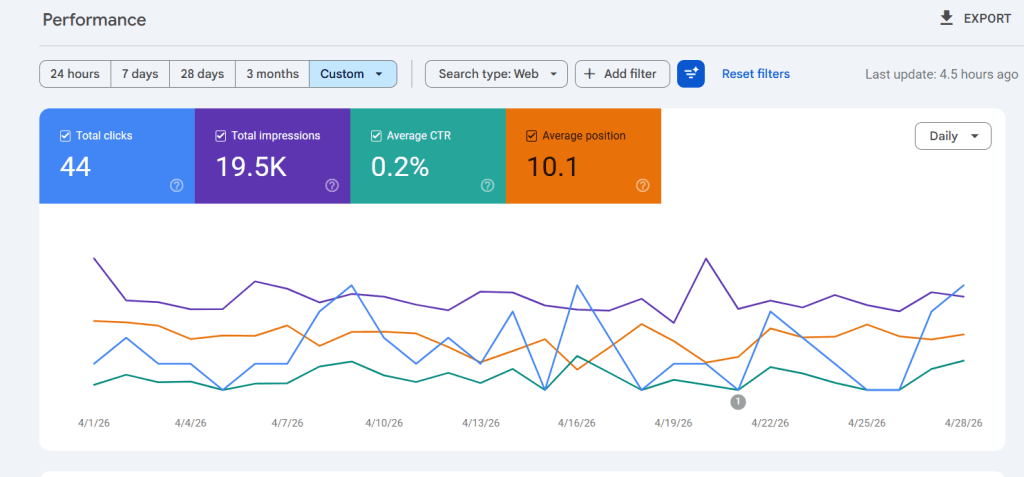
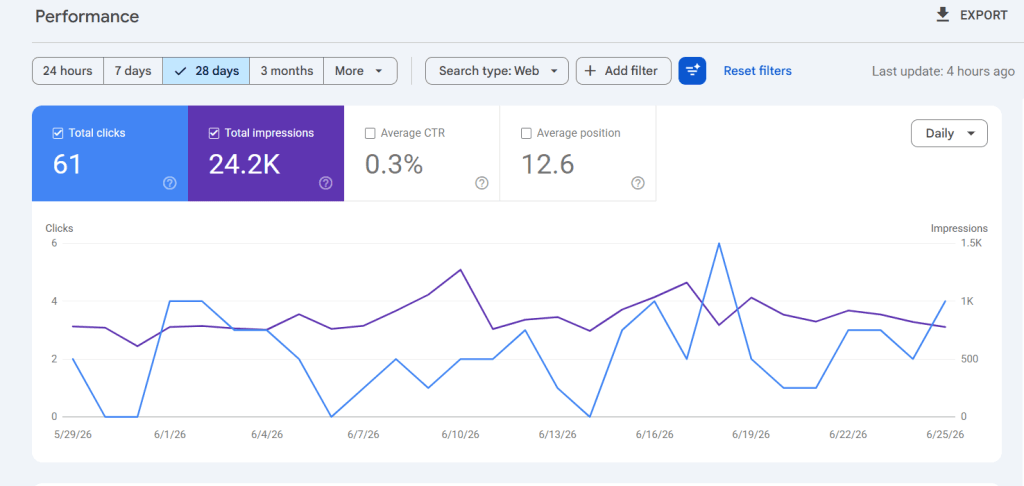
A residential and commercial painting contractor in Texas had a functioning website but was missing the localized, intent-specific content required to capture high-value painting searches across their expanding service area. A one-month on-page content sprint producing 30 dedicated service and location pages grew total impressions from 19,500 to 24,200, increased organic clicks from 44 to 61, and established a topical authority foundation capable of ranking across hundreds of long-tail painting keywords in the Texas market, entirely through on-page SEO with no link building involved.
Result Snapshot
Before
After
| Metric | Before (April 2026) | After (June 2026) |
|---|---|---|
| Total Impressions | 19,500 | 24,200 |
| Impression Growth | — | +4,700 impressions |
| Organic Clicks | 44 | 61 |
| Click Growth | — | +17 clicks (+38%) |
| Average CTR | 0.2% | 0.3% |
| Average Position | 10.1 | 12.6 |
| Pages Built | Existing site | +30 new dedicated pages |
| Backlinks Built | 0 | 0 |
| Data Source | Google Search Console | Google Search Console |
About the Client: A Residential and Commercial Painting Contractor Growing Across Texas
This client operates a residential and commercial painting business serving multiple neighborhoods and service areas across Texas. The business handles a full range of interior and exterior painting projects for homeowners and commercial property managers, including services such as exterior house painting, interior room painting, cabinet refinishing and commercial space repaints.
Texas is a large and geographically diverse painting services market. Demand is consistent across both residential and commercial segments, with homeowners in suburban neighborhoods, property managers in commercial districts and new-build developers all representing distinct customer types with specific search behavior. A painting contractor that wants to grow beyond its immediate locality in Texas cannot rely on a homepage and a single services page to capture that demand. The customers searching for painting services in Plano, Katy, Round Rock or Cedar Park are using location-specific search terms, and a website without pages that match those terms is simply not visible to them, regardless of how good the actual painting work is.
The Problem: A Website That Existed but Could Not Be Found for the Searches That Matter
The business had a baseline web presence and was generating some organic impressions, approximately 19,500 per month, before the campaign began. The problem was not total invisibility but structural incompleteness. The existing website could not capture the full range of localized, intent-specific searches that represent genuine painting service demand in Texas.
A homeowner in a Texas suburb who searches “exterior house painter near Katy TX” or “cabinet refinishing residential Texas” is not going to find a painting contractor whose website has a generic services page and no location-specific content. That search goes to a competitor with a dedicated page for that service in that area. Multiply this pattern across dozens of Texas neighborhoods and across multiple painting service types, and the gap between what the website could capture and what the Texas painting market was actually searching for represented a significant and measurable revenue opportunity being left entirely to competitors.
The business also had no content infrastructure targeting commercial painting clients, whose search behavior and language differs substantially from residential searchers. A commercial property manager searching for a contractor for a multi-room office repaint uses different terms, has different questions and responds to different content signals than a homeowner painting a bedroom. Serving both without dedicated content for each means serving neither well in search.
Root Cause Analysis: Why a General Website Cannot Rank Across a Geographically Dispersed Market
Google’s local and organic ranking algorithm rewards relevance, and relevance in a geographically spread market requires geographic specificity. A single services page listing “residential and commercial painting in Texas” does not send a relevance signal for any specific neighborhood in Texas. It sends a generic signal that competes weakly against hundreds of other painting contractors who have built location-specific pages over time.
The second structural gap was service-level specificity. Exterior painting, interior painting, cabinet refinishing and commercial painting are not variations of the same search. They are distinct search intent categories with their own keyword clusters, their own searcher concerns and their own ranking factors. A website that groups all of these services onto a single page competes for the broadest, most generic version of each search while missing the longer-tail queries where conversion intent is often higher and competition is lower.
The third gap was topical authority. Google’s algorithm rewards websites that demonstrate comprehensive coverage of a topic. A painting contractor website with five or six pages signals limited expertise compared to a competitor with forty pages covering every service variation, every neighborhood and every customer type across Texas. This topical depth is not about keyword stuffing, it is about demonstrating to the algorithm that the website is a genuine, comprehensive resource for painting services in this market.
None of these gaps could be addressed by a single optimized homepage update or a metadata rewrite. They required the creation of new content pages, built systematically and optimized individually for specific search intents.
The Strategy: Build Topical Authority Through a Structured 30-Page Content Sprint
The decision was to concentrate the entire campaign on on-page content architecture rather than off-page link building or technical SEO fixes. This was the correct choice for three specific reasons.
First, the website’s underlying technical structure was functional. There were no crawl errors, indexation problems or speed issues preventing Google from processing new content correctly. Building links to a technically sound site with a content gap produces weaker returns than filling the content gap first, because search engines need relevant pages to rank before backlinks to those pages have anything to amplify.
Second, a structured content sprint produces indexable results faster than a link-building campaign. New pages can be written, published and submitted to Google’s index within days. A link-building campaign producing meaningful authority typically requires months of outreach and relationship building before the ranking impact appears. For a painting contractor in Texas looking to expand search coverage within a realistic business timeline, content was the right lever.
Third, the Texas painting market has a well-documented pattern of regional search demand across dozens of cities and neighborhoods. A contractor that owns content across this geographic footprint does not just rank for individual terms. They rank for hundreds of long-tail variations simultaneously, compounding organic visibility faster than a homepage-focused strategy can achieve.
The Execution: Thirty Dedicated Pages Built and Published in One Month
Phase 1: Intent Mapping and Content Architecture (Week 1)
The first week was spent mapping the Texas painting market’s search demand across two axes: service type and geographic location. This produced a content grid identifying which service categories needed dedicated pages and which Texas locations represented the highest-value target areas for the business’s current service footprint.
The service categories mapped included:
- Exterior house painting, as a standalone service with its own search intent and keyword cluster distinct from interior work.
- Interior painting services, covering room-specific and whole-home variants.
- Cabinet refinishing and cabinet painting, which represent a high-value, high-intent service category with specific search language.
- Commercial painting, targeting the property manager and business owner search audience separately from residential searchers.
Location targeting was structured around specific Texas neighborhoods, suburbs and service areas where the business was actively operating or expanding into, ensuring every location page reflected genuine service availability rather than speculative geographic targeting.
Phase 2: Page Creation and On-Page Optimization (Weeks 2 to 4)
Thirty individual pages were written and published across the four-week sprint. Every page followed a consistent on-page optimization framework applied individually to its specific service and location combination:
The H1 heading on each page was written to match the precise search query the page was targeting, incorporating both the service type and the geographic modifier naturally. Generic H1s like “Painting Services” were replaced with specific, search-matched headings that signal clear relevance to Google’s crawler.
H2 subheadings were structured to cover the secondary questions and concerns a searcher would have after landing on that page. For an exterior painting page targeting a specific Texas suburb, the subheadings addressed questions about preparation, materials, weather considerations in Texas and what the project process looks like. This structure serves both the searcher’s need for complete information and Google’s preference for comprehensive topic coverage.
Meta titles and descriptions were written individually for each page with click-through rate as the primary objective. A Texas homeowner scanning search results for exterior painters sees dozens of generic titles. A result with a title that names their specific suburb and their specific service need, paired with a description that answers their first question before they click, earns the click at the same ranking position more reliably than a generic competitor entry.
Internal linking was structured as a silo: the main service category pages linked to their location-specific variants, and the location pages cross-linked to related service pages within the same geographic area. This silo structure concentrates the website’s existing authority toward the pages most likely to rank for high-converting searches and signals to Google the topical relationship between pages in the same cluster.
Content depth was set at a level appropriate for the specific page’s topic. Location pages for high-competition Texas suburbs received more comprehensive content covering local context, neighborhood-specific considerations and customer concerns relevant to that area. Niche service pages like cabinet refinishing received content depth that covered the process, materials and outcomes in enough detail to serve both searcher intent and topical authority requirements.
One complication arose during the sprint: several service and location combinations had overlapping keyword targets that needed to be differentiated carefully to avoid cannibalization. Pages targeting adjacent Texas suburbs with similar search volumes required distinct angles, specific local references and different structural approaches to ensure they competed for different segments of the keyword landscape rather than splitting authority against each other. Resolving these conflicts added review time in weeks three and four but produced a cleaner, more defensible content architecture.
The Results: 24,200 Impressions, 61 Clicks and a Position Metric That Tells the Real Story
By June 2026, total impressions had grown from 19,500 to 24,200, organic clicks had increased from 44 to 61 and click-through rate had improved from 0.2% to 0.3%. All of this growth came from organic search, with no paid traffic, no link building and no off-page work of any kind.
The average position metric moved from 10.1 to 12.6, and this number deserves a direct, honest explanation rather than being glossed over. When 30 new pages are indexed across a wide range of keywords, those pages begin ranking immediately, but typically in the middle and lower sections of Google’s results, positions 11 through 30, as the algorithm evaluates them against established competitors. This initial ranking behavior mathematically lowers the overall average position across the website, because the new pages are pulling the average downward while they build the relevance and behavioral signals needed to move higher.
This is what happened here. The 30 new pages began ranking across hundreds of long-tail Texas painting keywords at positions that are below the site’s established pages but above the threshold where impressions are recorded. The result was a large net increase in impressions (confirming the pages are visible in search), a meaningful increase in clicks (confirming the pages are generating real engagement), and a lower average position (confirming that new pages at initial ranking positions are diluting the site-wide average as expected). This is a mathematically correct outcome of a content expansion strategy, not a performance problem.
As these pages accumulate behavioral signals over the weeks and months following the sprint, their individual positions will improve and the average position metric will recover and surpass its pre-sprint baseline. The impression and click trajectory at the close of the June tracking window was still moving upward, which is the accurate leading indicator of where the campaign is heading.
If you run a painting business in Texas and your website is not capturing the local searches your potential customers are using, the gap between your current content and the full demand in your market is almost always larger than it appears. Book a free video call or send a message on WhatsApp to look at exactly which Texas painting searches your site is currently missing.