


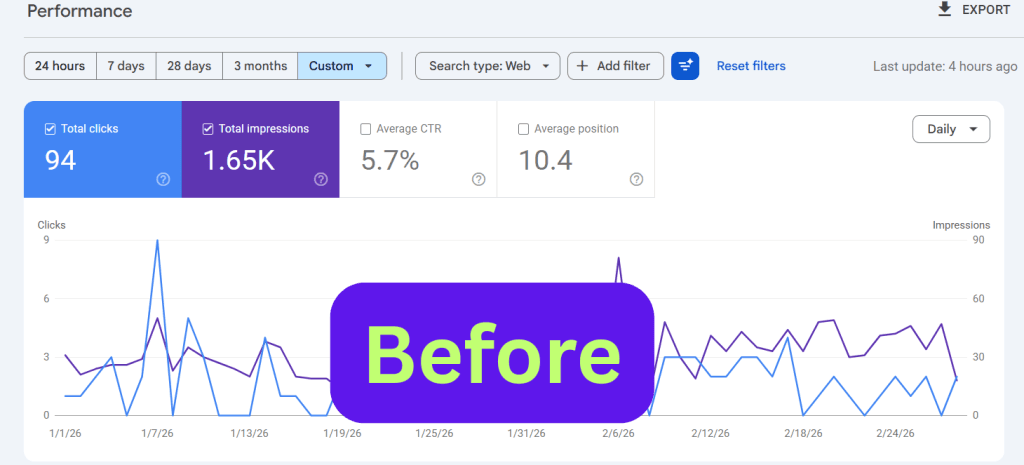
A regional e-commerce brand with a physical presence in Pompano Beach, South Florida was sitting at an average ranking position of 10.4 across its most profitable buyer keywords, close enough to page one to generate impressions but too far down to convert them into clicks. A two-month hybrid e-commerce and local SEO sprint targeting the exact same keyword set pushed average position from 10.4 to a confirmed 8, drove click-through rate from 5.7% to 7.9%, and grew organic clicks from 94 to 133, a 41% increase in high-intent buyer traffic, with total impressions remaining nearly flat across both periods.
Result Snapshot
Before
After
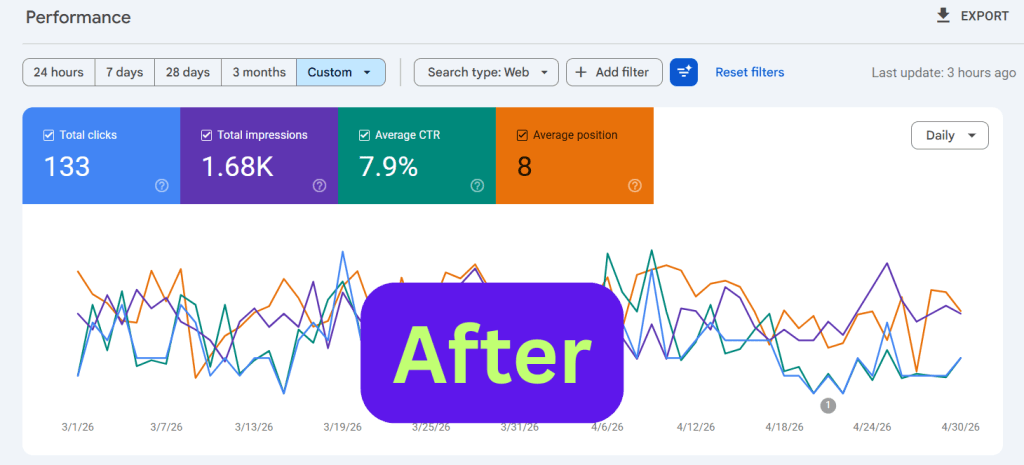
| Metric | Baseline (Jan-Feb 2026) | Post-Sprint (Mar-Apr 2026) |
|---|---|---|
| Average Position | 10.4 | 8.0 |
| Total Organic Clicks | 94 | 133 |
| Click Growth | — | +39 clicks (+41%) |
| Click-Through Rate | 5.7% | 7.9% |
| CTR Growth | — | +2.2 percentage points |
| Total Impressions | 1,650 | 1,680 |
| Impression Change | — | Near-flat (+30) |
| Strategy Type | — | Hybrid e-commerce and local SEO |
| New Keywords Targeted | 0 | 0 – same keyword set repositioned |
| Data Source | Google Search Console | Google Search Console |
About the Client: A Regional E-Commerce Brand With Local Roots in Pompano Beach
This client operates a regional e-commerce brand selling to buyers across South Florida, with a physical presence in Pompano Beach. The business serves both online shoppers and local customers who value proximity for fast delivery or in-person pickup, making it a genuine hybrid between a traditional e-commerce store and a local retail operation.
Pompano Beach sits in the Broward County corridor between Fort Lauderdale and Boca Raton, a densely populated and commercially active stretch of South Florida with high consumer purchasing power and strong e-commerce adoption. Buyers in this market are accustomed to fast fulfillment and frequently use geo-modified search terms that combine product intent with South Florida location signals. A search like “buy [product] Pompano Beach” or “same day [product] South Florida” is not a long-tail curiosity. It is a high-converting buyer query from someone who wants to complete a purchase, not browse.
The business was generating real organic visibility for exactly these kinds of buyer queries before the project began. The problem was positioning, not reach.
The Problem: Visible But Unreachable on Page 2
The baseline Google Search Console data from January and February 2026 revealed a specific and diagnosable situation. Total impressions of 1,650 confirmed the website was appearing in search results for relevant buyer queries across South Florida. An average position of 10.4 confirmed those appearances were happening almost entirely on page two of Google’s results.
The commercial consequence of position 10.4 in an e-commerce context is straightforward. Research across the SEO industry consistently shows that page one results capture the overwhelming majority of clicks for any given search query, with positions one through three alone accounting for the majority of total clicks. Position 10.4 means the website was appearing at the bottom of page one or the top of page two depending on the specific query, in the zone where click-through rates collapse. The baseline CTR of 5.7% confirmed this: the site was earning clicks from a small fraction of the searchers who saw it.
For a South Florida e-commerce brand where each click represents a potential buyer with purchase intent, the gap between 5.7% and what a page one position would produce was not a minor optimization opportunity. It was a measurable revenue gap being conceded to page one competitors every single day.
Root Cause Analysis: Why a Well-Ranked Site Gets Stuck at the Page 1 Boundary
The page 2 trap is one of the most specific and frustrating positions in organic search. The business had done enough right to rank for its target keywords, which means the foundational SEO was functional. The problem was a cluster of marginal factors that, in aggregate, prevented the final few positions of movement needed to cross from position 10 into position 8 or above.
The first factor was product and category page optimization. E-commerce pages in a regional market like South Florida frequently have thin, manufacturer-supplied or generic product descriptions that do not include the geographic and intent-specific language that signals relevance to a local buyer search. A product page that does not include Pompano Beach, South Florida or Broward County in its content structure does not send a relevance signal for geo-modified buyer queries, regardless of how well-optimized the homepage is.
The second factor was click-through rate at the existing position. Google uses CTR as a relevance signal. When a page appears at position 10 and earns a lower-than-expected CTR for its ranking, the algorithm interprets this as a signal that the result is less relevant or less compelling than its position suggests. This suppresses ranking improvement. Meta titles and descriptions that do not clearly communicate purchase intent and geographic relevance to a South Florida buyer earn lower CTRs, which reinforces the page’s position rather than allowing it to improve.
The third factor was the disconnect between the physical local presence in Pompano Beach and the website’s organic signals. For a hybrid e-commerce and local business, the Google Business Profile is a trust and relevance amplifier for the website. A profile that is not synced with the website’s product and category intent, or that does not have its product listings connected to the corresponding e-commerce pages, misses the opportunity to send a consistent local entity signal that reinforces the website’s relevance for South Florida buyer searches.
The fourth factor was schema markup. E-commerce pages without structured data markup require Google to infer product information, pricing, availability and review signals from unstructured content. Competitors whose pages include proper Product schema, LocalBusiness schema and Review markup provide Google with explicit, structured signals that are easier to process and reward with higher placement. In a market as competitive as South Florida e-commerce, the absence of schema markup is a competitive disadvantage at the margin where positions 8 through 11 are decided.
The Strategy: Precision Repositioning of Existing Keywords, Not Volume Expansion
The strategic decision at the start of this project was to focus exclusively on repositioning the website’s existing keyword set rather than expanding into new keyword territory. This distinction matters enormously for how the results are interpreted.
Many e-commerce SEO campaigns measure success by growing total impressions through the addition of new, often lower-intent keyword targets. Impression growth looks impressive in a report but can mask the fact that the new impressions are coming from searchers who are not close to making a purchase. This campaign deliberately avoided that approach.
The baseline data showed the website already had the right keyword exposure for its South Florida buyer audience. The 1,650 impressions in January and February came from genuine, high-intent searches. The problem was not reach. It was conversion of existing reach into clicks and visits. That distinction required a different set of interventions than a standard content expansion campaign.
The two-month plan concentrated on four specific levers: product and category page geo-optimization for the South Florida market, metadata rewriting for click-through performance at the existing position, schema markup implementation across product and category pages, and GBP synchronization with the e-commerce product intent.
The Execution: Two Months of Precision Optimization Across Product Pages, Metadata and Local Signals
Phase 1: On-Page Geo-Optimization of Product and Category Pages (Weeks 1 to 3)
The first phase addressed the content gap between what the product and category pages said and what a South Florida buyer query expects to find. Product pages were reviewed individually and rewritten to incorporate natural geographic relevance without sacrificing the product description’s commercial purpose.
This involved embedding Pompano Beach, South Florida and Broward County references in specific, contextually appropriate locations within each page, including the opening paragraph, the delivery and availability section and the supporting content that addresses local buyer concerns such as pickup options and regional shipping timelines. The goal was to make each page feel written for a South Florida buyer rather than a generic national audience, which is exactly what a local buyer’s search query is looking for when it includes a geographic modifier.
Category pages received the same treatment, with additional attention to the heading structure. H1 and H2 headings on category pages were rewritten to include service-area language that matched the actual search terms South Florida buyers use when browsing product categories rather than searching for specific items.
Phase 2: Metadata Rewrite for Click-Through Rate Performance (Weeks 2 to 4)
Every meta title and meta description across the priority product and category pages was rewritten with a single objective: earn more clicks at position 10 than the previous versions earned, which would signal to Google that the pages deserved to move higher.
Meta titles were restructured to lead with the product or category name and follow with a South Florida or Pompano Beach geographic qualifier, in the format that South Florida buyers most commonly see and respond to in search results. Generic titles that read like database exports were replaced with intent-matched titles that clearly communicate what the page offers and where it can be fulfilled.
Meta descriptions were rewritten as conversion micro-pitches. For a South Florida e-commerce buyer who sees two results at the same ranking position, the description that mentions local availability, fast delivery or in-person pickup in Pompano Beach earns the click over a generic product description. Every rewritten description included a specific purchase-oriented call to action and at least one South Florida relevance signal.
This metadata work addressed the CTR suppression problem directly. By improving CTR at the existing position before rankings improved, the campaign created the behavioral signal that Google needed to begin moving the pages upward.
Phase 3: Schema Markup Implementation (Weeks 3 to 5)
Structured data markup was implemented across product and category pages using Product schema, LocalBusiness schema and Review schema where applicable. This gave Google explicit, machine-readable signals about the nature of each page’s content, the business’s physical presence in Pompano Beach and the social proof signals associated with individual products.
One complication arose during the schema implementation phase. Several product pages had conflicting structured data remnants from a previous partial implementation that had been abandoned, leaving invalid markup that was generating errors in Google Search Console without visibly affecting the site. These conflicts had to be identified, removed and replaced cleanly before the new schema could be submitted without error. This cleanup added approximately four to five days to the implementation timeline but produced a clean structured data profile across the entire priority page set.
Phase 4: GBP and E-Commerce Alignment (Weeks 4 to 6)
The Google Business Profile was reviewed and restructured to function as a trust and relevance amplifier for the e-commerce website rather than a standalone local listing. The GBP Products section was populated with the business’s priority product categories, with descriptions and naming conventions that matched the language used on the corresponding website pages and the search terms South Florida buyers use.
This alignment created a consistent entity signal across the website and the local profile. When Google sees a business’s GBP product listings and website category pages using the same product language, the same geographic references and the same intent signals, it receives a reinforced relevance confirmation that contributes to ranking improvement for the queries where both assets are active.
Google Posts were also used during this phase to reinforce South Florida and Pompano Beach locality signals around specific product promotions and inventory updates, keeping the profile active and signaling geographic relevance on an ongoing basis.
The Results: Page 1, 41% More Clicks, and the Same Keywords That Were Already There
By the end of April 2026, the Google Search Console data confirmed the campaign’s outcome across every metric that matters for an e-commerce business.
Average position improved from 10.4 to 8.0, crossing the page one threshold. Click-through rate grew from 5.7% to 7.9%, confirming that the metadata rewrite and positioning improvement were working together to convert impressions into clicks at a higher rate. Organic clicks increased from 94 to 133, a 41% increase in buyers visiting the site from organic search.
Total impressions across both periods were 1,650 before and 1,680 after, a difference of just 30 impressions across two months. This near-flat impression count is the most important number in the entire dataset for understanding what this campaign was and was not. It was not a traffic inflation campaign. No new irrelevant keyword targets were added to manufacture impression growth. Every additional click came from the same South Florida buyer searches that were already generating impressions in January and February, now producing 41% more visits because the pages were ranking on page one and earning higher CTRs.
For a Pompano Beach e-commerce brand operating in a market where buyer intent is high and competition for page one placement is real, 39 additional organic clicks per two-month period from a targeted buyer audience represents genuine commercial value. The position and CTR trajectory at the close of April 2026 suggested continued improvement in both metrics as the behavioral signals accumulated from the new page one positions.
If you run an e-commerce brand in South Florida with a local presence and your site is generating impressions but not converting them into buyer traffic, the gap between your current ranking position and page one is often smaller than it appears. Send a message on WhatsApp or book a free video call to review your Search Console data together.