


A brand-new property maintenance contractor in New York launched its website with no prior domain history, no established entity signals and no local search presence. The late March 2026 baseline showed 248 impressions at an average position of 68.6, predominantly from irrelevant, broad queries that Google was using to classify an unknown new domain. A two-month technical foundation and local SEO campaign built the site’s entity clarity from zero, shed the irrelevant impression traffic intentionally, and repositioned the domain from page seven to mid-page two, moving average position to 14.8 while growing click-through rate by six times, from 0.8% to 4.8%, and generating the domain’s first ten qualified organic clicks from high-intent local property service searches in New York.
Result Snapshot
Before
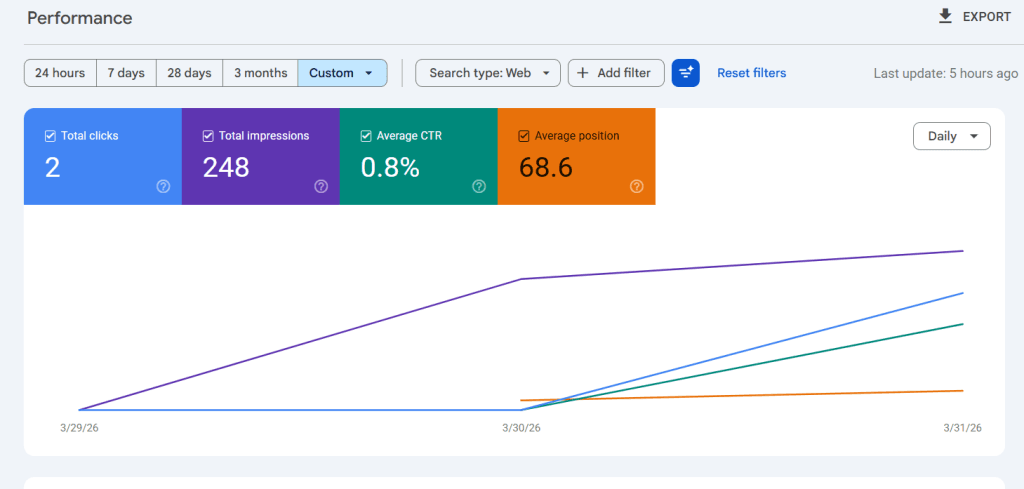
After
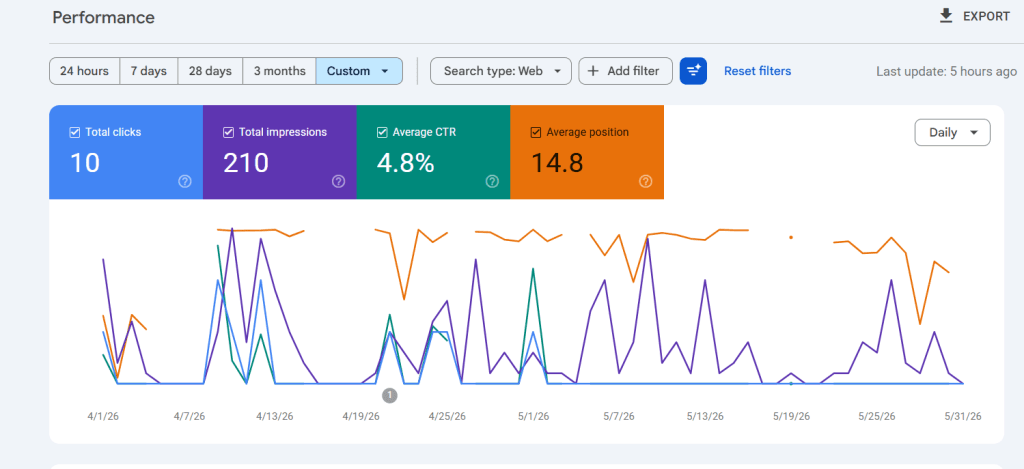
| Metric | Baseline (Late March 2026) | Post-Optimization (April to May 2026) |
|---|---|---|
| Average Position | 68.6 (page 7) | 14.8 (mid-page 2) |
| Position Improvement | — | +53.8 positions |
| Total Organic Clicks | 2 (accidental) | 10 (qualified) |
| Click-Through Rate | 0.8% | 4.8% |
| CTR Growth | — | 6x increase |
| Total Impressions | 248 (broad, irrelevant) | 210 (targeted, intent-matched) |
| Impression Change | — | Intentional consolidation |
| Domain Age at Start | 2 months old | 4 months old |
| Website Platform | WordPress | WordPress with Rank Math |
| Local Schema Implemented | None | LocalBusiness schema with zip-code mapping |
| Data Source | Google Search Console | Google Search Console |
About the Client: A Property Maintenance Contractor Launching Their Digital Presence in New York
This client is a local property maintenance and services contractor in New York, offering residential and commercial property upkeep, repair coordination and maintenance services across their target service area. The business was operationally ready to serve clients when this project began, but had no established digital presence, no domain history and no local search visibility of any kind.
For a property services contractor entering the New York market, organic search is a foundational acquisition channel. New York property owners, building managers and residential clients searching for reliable maintenance contractors rely heavily on Google search to evaluate and shortlist service providers. A business that cannot appear in organic results for local property maintenance searches in New York is, from a digital perspective, functionally invisible to the most accessible and highest-intent customer pool available to them.
The challenge of launching a new website in New York’s property services market is compounded by the competitive density of the local contractor landscape. Established competitors have accumulated months or years of domain authority, review signals and citation presence. A new domain enters this environment at maximum disadvantage and must build every trust and relevance signal from zero before Google will begin positioning it competitively in search results.
The Problem: A Brand-New Domain Lost in the Google Sandbox
The baseline Search Console data from late March 2026 captured the domain in its raw, unoptimized state within days of going live. The numbers reflected the typical condition of a new website that has been indexed by Google but not yet understood by it.
Total impressions of 248 indicated that Google was beginning to crawl and categorize the site, but at position 68.6, the site was appearing on page seven of search results. At this position, the impressions are almost entirely academic. Real searchers do not scroll to page seven. The 0.8% CTR and 2 total clicks across the baseline period confirmed this: the site was technically present in Google’s index but generating no meaningful organic traffic from any search with real commercial intent.
The more important story behind the baseline data was the nature of those 248 impressions. At position 68.6, a new domain is not appearing for its target keywords. It is appearing for broad, tangentially related queries that Google is using as it attempts to classify an unknown entity. A new property maintenance website in New York might appear on page seven for queries like “property,” “maintenance services,” or “building services” because Google has not yet determined that the site is specifically relevant to local property maintenance searches in a defined New York service area. These impressions have no commercial value and no connection to the local buyer intent the business needs to capture.
This is the Google Sandbox in its practical form: a new domain period during which Google applies conservative ranking positions while it accumulates enough behavioral and structural data to assess the site’s quality, relevance and trustworthiness. Escaping the Sandbox requires demonstrating clarity of entity, precision of local relevance and technical correctness, not volume of content or quantity of backlinks.
Root Cause Analysis: Why New Domains Start at Page Seven and What It Actually Takes to Escape
The Google Sandbox is not a penalty. It is a trust calibration period. Google’s algorithm is designed to prevent new, unverified websites from immediately ranking for competitive terms before their quality has been assessed. For a local contractor in New York, this calibration period is particularly pronounced because the property services niche has historically attracted low-quality doorway sites and thin-content local pages, making Google’s initial skepticism toward new domains in this category heightened.
The first structural gap in the baseline site was entity ambiguity. Google’s local search algorithm needs to understand precisely what a business is, what it does and where it does it before it can confidently match the site against local service searches in New York. A new website without structured data markup, without clearly defined service area signals and without precise local intent language in its core on-page elements presents Google with an ambiguous entity that cannot be confidently positioned for specific local searches.
The second gap was the absence of Local Business schema. Schema markup is the mechanism through which a website explicitly communicates structured information to search engines in a machine-readable format. For a new property maintenance contractor in New York, LocalBusiness schema that specifies the business type, the services offered, the geographic service area and the zip codes served is the most direct and effective way to accelerate Google’s entity understanding. Without it, the algorithm must infer all of this information from unstructured page content, which is slower and less precise.
The third gap was on-page structure misalignment. The site’s meta titles, descriptions and heading architecture were not configured to match the specific, high-intent local search language that New York property maintenance clients use. When a site’s on-page language does not closely match the searcher’s query language, Google’s algorithm has lower confidence in the relevance match, which suppresses ranking position even further for a domain that is already operating from a new-site disadvantage.
The fourth issue was the broad impression noise. The 248 impressions at position 68.6 were not a foundation to build on. They were a signal that Google was exploring the site’s relevance across a wide, unfocused range of queries, none of which were the actual local property maintenance searches the business needed to capture. Before rankings could improve, the site needed to send clear enough relevance signals that Google would stop appearing it for broad irrelevant queries and start appearing it for specific, local, high-intent ones.
The Strategy: Teach Google Exactly Who This Business Is Before Chasing Traffic
The strategic principle for the first sixty days was entity clarity over traffic volume. This is the correct approach for any new domain in a competitive local market, but it is particularly important in New York, where the property services market is populated by established competitors that have years of entity signals, citation presence and behavioral data working in their favor.
Attempting to generate traffic from a new domain that Google does not yet understand produces no useful result. The algorithm cannot reward a site it cannot classify. Every optimization effort before entity clarity is established is essentially working against a locked door. The correct sequence is to build the structural foundation that allows Google to classify the business accurately, then allow the ranking improvement to follow from that clarity, and then build on the initial rankings to drive traffic and conversion.
This sequencing explains every decision made in the campaign. The goal was not to produce impressive impression numbers or to chase rankings for broad terms. It was to build a technical and structural foundation so precise that Google would have no uncertainty about what this property maintenance contractor in New York does, where it serves and why it should be shown for local property service searches in its target zip codes.
The Execution: Sixty Days of Technical Foundation, Schema Deployment and On-Page Precision
Phase 1: WordPress Architecture Setup for Local SEO (Week 1 to 2)
The website’s WordPress structure was built and configured specifically for local SEO performance from the ground up. This meant establishing a clean, crawlable site architecture with a logical page hierarchy: a homepage establishing the brand and primary service area, dedicated service pages for each distinct property maintenance service category, and a structure that allowed Google to understand the relationship between the business, its services and its geographic service territory in New York.
Rank Math was configured as the on-page SEO framework. Every indexable page received a unique, precisely configured meta title and meta description written to match the exact search intent of a New York property owner or building manager searching for that specific service. Generic titles were replaced with intent-specific constructions that communicated service type, geographic specificity and the searcher’s most immediate concern in the format that Google’s search results display most effectively.
Crawl directives were reviewed to confirm that no pages were being inadvertently blocked from indexation and that the XML sitemap was correctly configured and submitted to Google Search Console. For a new domain, these technical basics carry outsized importance because any crawl obstruction delays the indexation that must happen before rankings can begin to develop.
Phase 2: Local Business Schema Implementation and Zip Code Mapping (Weeks 2 to 4)
The single highest-impact technical action in this campaign was the implementation of LocalBusiness schema markup across the site, with precise geographic service area mapping down to the specific New York zip codes the contractor serves.
The schema implementation specified the business type as a property maintenance and local service contractor, enumerated the services offered in the vocabulary Google’s algorithm uses to classify local service businesses, included the business’s contact and operational data in structured format and mapped the geographic service territory to specific zip codes rather than just the city name. This precision gave Google a complete, machine-readable entity profile for the business rather than requiring the algorithm to infer any of it from unstructured content.
Zip-code-level service area schema is particularly important in New York because the city’s geographic complexity means that a property maintenance search in one borough or neighborhood has different competitive dynamics and different proximity expectations than the same search in another. A schema implementation that specifies the exact service territory removes ambiguity about where the business’s local relevance applies.
The schema was validated through Google’s Rich Results Test tool before submission to confirm it was error-free and properly structured. Common schema errors on new WordPress implementations, including duplicate markup from poorly configured plugins and conflicting markup from theme defaults, were identified and resolved during this phase.
Phase 3: On-Page Content Alignment and Local Intent Language (Weeks 3 to 5)
Every core service page was reviewed and rewritten at the content level to ensure the language used matched the precise search queries New York property owners and managers use when looking for maintenance contractors. This is a different task from keyword stuffing. It is about writing content that answers the actual questions a searcher has when they land on a property maintenance page from a local search, using the vocabulary they used to find it.
H1 and H2 headings on each service page were structured to match the primary and secondary keywords the page was targeting, with geographic specificity embedded naturally in the heading structure. A heading referencing the specific New York service area sends a stronger relevance signal for local searches in that area than a heading referencing only the service type without geographic context.
Internal linking between service pages and the homepage was structured to establish clear topical authority flows, ensuring that any domain authority accumulating on the homepage or higher-traffic pages could propagate to the individual service pages that needed ranking support.
Phase 4: Monitoring the Relevance Shift and Sandbox Exit Signals (Weeks 5 to 8)
Google Search Console data was monitored at the keyword level through weeks five to eight to track which queries were dropping out of the impression data and which were appearing for the first time. The expected pattern for a post-schema, post-optimization new domain is a consolidation of impressions around more relevant queries as the algorithm updates its classification of the site, followed by position improvement as behavioral signals from those more targeted impressions accumulate.
This pattern appeared in the data. Total impressions moved from 248 to 210, a reduction of 38 impressions. The reduction represented broad, irrelevant queries dropping out of the impression set as Google recalibrated its understanding of the site and stopped surfacing it for searches it was not relevant to. Average position simultaneously improved from 68.6 to 14.8 because the 210 remaining impressions were concentrated in queries where the site’s relevance was now precisely matched, producing competitive positions rather than page seven appearances.
The Results: Page 7 to Page 2, a 6x CTR Jump and the Foundation Set for Page 1
By the end of May 2026, the domain had moved from position 68.6 to 14.8 across its tracked keyword set, a 53-position improvement in sixty days achieved entirely through technical foundation work with no backlinks built and no paid traffic used. CTR grew from 0.8% to 4.8%, a six-times improvement reflecting the shift from broad irrelevant impressions to targeted, high-intent local property maintenance queries. Organic clicks grew from 2 to 10, representing the domain’s first genuine organic traffic from real local searchers in New York.
The impression reduction from 248 to 210 is the result that requires the most careful interpretation for a client or reader who encounters it without context. A decrease in impressions typically signals a loss of visibility. In this specific case, it signals the opposite. The 38 impressions that left the dataset were broad, non-local queries where the site was appearing at position 68 or worse and generating no clicks, no behavioral signals and no commercial value. The 210 impressions that remained were concentrated in local property service queries where the site was now appearing at a competitive position and generating real engagement. Trading 38 worthless impressions for 53 positions of improvement and a 6x CTR increase is a demonstrably correct outcome.
The position at the close of May 2026 is 14.8, sitting in the mid-range of page two. The technical foundation built during this campaign, entity-precise schema, locally intent-matched on-page structure and clean WordPress architecture, is the platform from which page one positioning is achievable through continued content development, citation building and review acquisition in the months ahead. The Sandbox has been exited. The entity is established. The trajectory from page two to page one is now a straightforward execution question rather than a structural problem.
If you are launching a new local service website in New York, or if your existing site has been live for months without generating meaningful organic traction, the problem is almost always a foundation issue rather than a traffic strategy issue. Send a message on WhatsApp or book a free video call to look at your domain’s current signals and identify exactly what Google needs to see before it starts ranking you competitively.