

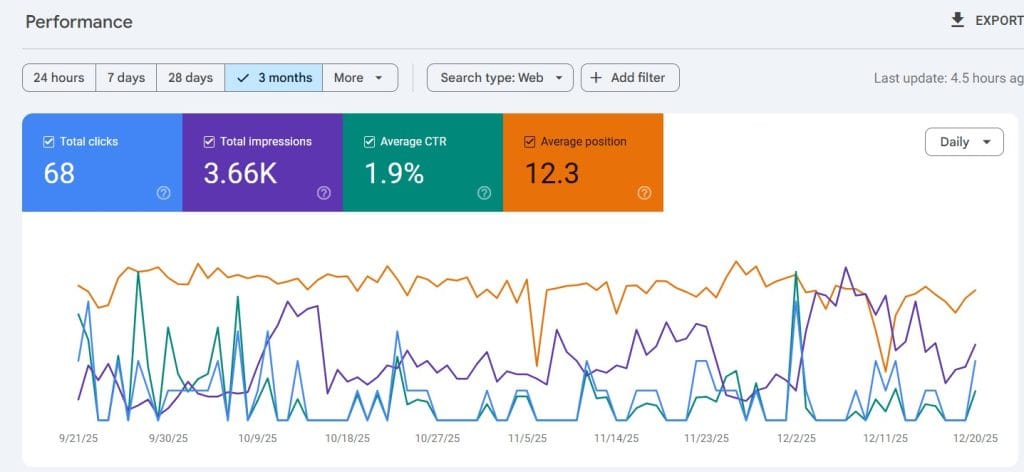
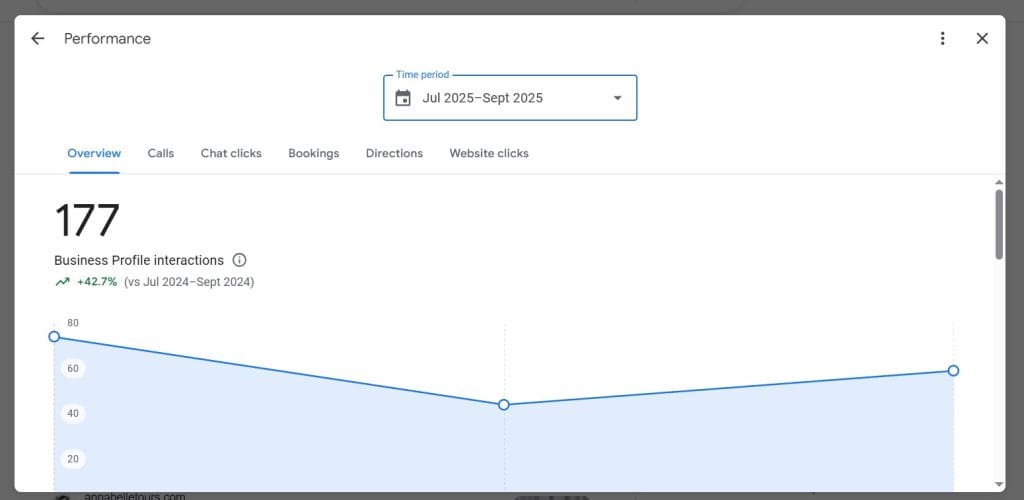
A Salzburg-based tour guide offering experiences in English, German, French and Italian had fragmented online presence and an untouched GBP Activities section. Multilingual tour guide SEO in Salzburg delivered a 42.7% year-over-year increase in Google Business Profile interactions, 3,660 organic impressions and 68 direct clicks over nine months before geopolitical travel disruptions ended the engagement, with the full SEO foundation intact for market recovery.
Result Snapshot
| Metric | Result Achieved |
|---|---|
| GBP Interactions (3-month window) | 177 total interactions |
| GBP Year-over-Year Growth | +42.7% vs same period prior year |
| Organic Search Impressions | 3,660 impressions across targeted queries |
| Organic Clicks | 68 direct clicks from search results |
| Average Ranking Position | 12.3 across all tracked keywords |
| Languages Served via Website Architecture | 4 (English, German, French, Italian) |
| Campaign Duration | 9 months |
| Closure Reason | Mutual agreement due to geopolitical travel disruption |
| SEO Foundation Status | Fully intact, ready for market recovery |
About the Client: An Independent Multilingual Tour Guide in One of Europe’s Most Competitive Tourist Cities
Salzburg occupies a specific position in European tourism that makes it both a high-opportunity and high-difficulty market for an independent operator. The city draws visitors from across Germany, Austria’s own domestic market, France, Italy, the UK and globally, pulled by Mozart’s birthplace, the filming locations of The Sound of Music, the UNESCO-listed Old Town and easy access to Alpine landscapes and lake district day trips. Tourism in Salzburg is not seasonal in the way beach destinations are. It operates year-round, with summer and the Salzburg Festival period representing peak volume, but shoulder seasons carrying genuine demand from culturally motivated international travelers.
This client was an independent tour guide, not an agency, not a platform listing. A single operator offering personally guided experiences across four languages: English, German, French and Italian. The multilingual capability was a genuine competitive differentiator in a market where most independent guides serve one or two language markets. A French-speaking couple, a German family and an English-speaking American visitor could each book with the same guide and receive a tour delivered entirely in their own language. That capability needed to be visible online in a way that matched how each of those audiences actually searched for tours.
The business had been operating for some time before this engagement began and had established a reputation through word-of-mouth and repeat referrals from travelers who had experienced the tours firsthand. What it lacked was a digital presence proportional to the quality and scope of what it offered.
The Problem: A Multilingual Tour Guide With a Monolingual Online Presence
The core problem was a structural mismatch between what the business offered and how that offering was represented digitally. The website existed but was built generically. A single “Tours” page listed everything the guide offered without differentiation by tour type, destination, language or audience. One page trying to rank for every tour the business offered is a page that ranks confidently for none of them.
The consequences were specific. A French tourist searching for a guided Salzburg tour in French found nothing on this website because there was no French-language content to find and no French search signals to surface. A German traveler searching for a private Sound of Music location tour encountered no dedicated page for that experience, only a general listing buried under every other offering. The website was producing searches that went nowhere and failing to capture the intent-specific queries that represent high booking probability.
The Google Business Profile had interactions occurring but the Activities section, the dedicated feature within GBP where a tour guide can list specific experiences with descriptions, durations, languages and pricing, had never been set up. That feature exists specifically for tour operators and guides. Leaving it empty is the equivalent of a hotel not listing its room types. The listing could be found but it communicated almost nothing about what the guide actually offered, how many languages it operated in or what made any individual experience worth booking.
The booking pipeline had a visible leak at every stage: missing language-specific web pages for the planning phase, an incomplete GBP profile for the Maps discovery phase and no structured content to help Google understand the breadth and specificity of what was on offer. The 42.7% interaction growth that was eventually achieved shows how much headroom existed from the starting point.
Root Cause Analysis: Why Generic Website Structure Fails a Multilingual Tourism Business
One Generic Tours Page Cannot Rank for Multiple Specific Experiences
Google’s search algorithm rewards specificity. When someone searches “Mozart walking tour Salzburg in English” or “Sound of Music tour guide Salzburg French”, they are expressing precise intent about the type of experience, the location and the language they need. A single catch-all tours page signals nothing specific about any of those parameters. Google cannot confidently return it as the authoritative answer to any of those queries because the page tries to be the answer to all of them at once.
Each specific tour offered by a guide represents a rankable asset if built as a dedicated page. A standalone page for a Mozart birthplace walking tour, written with the correct on-page elements, schema markup and supporting content, can rank confidently for the queries associated with that specific experience. A standalone page for Sound of Music filming location tours can do the same. These pages compete in narrower query pools than a generic tours page does, which means the authority required to rank is lower and the path to page one is significantly shorter.
The starting website had none of these individual assets. Every experience was collapsed into a single URL that could not rank specifically for anything.
Multilingual SEO Requires Language-Specific Architecture, Not Translation Plugins
Serving tours in four languages online is not the same as adding a translation toggle to a single website. From a search perspective, a translation plugin that dynamically converts English content into French does not produce French search rankings. Google indexes pages. A page that renders in French only when a visitor selects the language option but sits at the same URL as the English version is not a French web page. It is an English web page with a client-side language switch that Google largely ignores for ranking purposes.
The correct technical approach is separate URL structures for each language version of each page, with hreflang tags connecting them. A German-language page at /de/touren/ and a French-language page at /fr/visites/ are distinct indexable assets that Google can return separately for German-language and French-language searches. They signal to Google that the business actively serves German-speaking and French-speaking audiences, which is a relevance signal for searches in those languages. Without that architecture, the multilingual capability of the business was invisible to search entirely.
The GBP Activities Section Is Not Optional for Tour Guide Businesses
Google built a dedicated experience management feature into GBP specifically for tour operators, activity providers and guides. It allows a business to list individual tour experiences with structured fields: experience name, description, duration, language, group size and price. Google uses this data for local ranking decisions and for surfacing specific experiences in Maps results and Knowledge Panel displays.
An empty activities section tells Google that this GBP listing belongs to a business with no structured experience to offer. In a city like Salzburg where competing tour operators and platform listings fill out their GBP activities in detail, leaving this section blank is a direct ranking disadvantage. The relevance signals that Google uses to match a search for “private Salzburg walking tour in German” to a GBP listing depend heavily on what is populated in those structured fields.
The Strategy: Build Language-Specific Assets and Map Them Directly to GBP Activities
The strategic decision made at the start of this engagement was to treat the website and the GBP as connected systems rather than separate channels to optimize independently. Every specific tour page built on the website would have a corresponding GBP activity entry that linked to it. Every language version of a page would be built with the architecture that Google could index and rank independently. The two assets would reinforce each other rather than operating in isolation.
The alternative approach would have been to optimize the GBP first for faster early results and then build the website architecture over the following months. That sequencing was rejected because the GBP optimization for a multilingual tour guide depends on having destination pages to link to. GBP activities that link to a live, specific, well-optimized tour page generate both a more complete user experience and stronger combined signals than GBP activities that link to a generic homepage or a catch-all tours page.
Content depth and specificity were prioritized over content volume. Fewer pages built correctly from the first version outperform a large volume of thin pages that need to be rebuilt later. For a multilingual operation across four languages, getting the architecture right before scaling content was non-negotiable. A structural mistake in a multilingual site affects every language version simultaneously.
The Execution: Nine Months of Multilingual SEO Architecture, GBP Mastery and Active Presence Building
Phase 1 (Weeks 1 to 4): Full Audit, Architecture Design and Multilingual URL Planning
The first month began with a complete audit of the existing website, the GBP listing and the competitive landscape in Salzburg tourism search. The audit produced three clear findings. The website’s URL structure was flat and undifferentiated. The GBP activities section was completely empty. The competitive SERPs for Salzburg tour queries were dominated by aggregator platforms in German and English but significantly weaker in French and Italian, which represented the first tangible opportunity gaps for a multilingual operator.
The multilingual URL architecture was planned in detail before a single new page was built. The agreed structure created separate language directories: /en/ for English, /de/ for German, /fr/ for French, and /it/ for Italian. Within each language directory, tour-specific pages were planned for every experience the guide offered. This meant that a Sound of Music locations tour would have four independently indexable pages, one in each language, each written for that language’s search audience and each linked to the others via hreflang tags.
Hreflang implementation was planned at the template level rather than added page by page. For a four-language, multi-tour site, manually managing hreflang across every page combination is error-prone. Getting the hreflang logic right in the template meant every new page published in any language would automatically generate the correct hreflang relationships to its counterparts.
Phase 2 (Weeks 4 to 14): Building Dedicated Destination and Tour Pages Across All Four Languages
The page building phase was the most time-intensive part of the engagement. Each specific tour experience required a dedicated page in all four languages. Experiences covered included Mozart’s birthplace and childhood home walking tours, Sound of Music filming location tours, Hohensalzburg Fortress and Old Town historical tours, lake district and Hallstatt day trip experiences and private custom tour options.
The content for each page was not mechanically translated from the English version. Each language version was written with the search behavior of that language’s audience in mind. German-speaking searchers use different query structures and terminology than French-speaking searchers looking for the same experience. A French-language page for a Sound of Music tour was written around the French search terms tourists from France or French-speaking Switzerland would actually use, not a literal translation of the English page’s keyword choices.
Schema markup was implemented on every page using LocalBusiness and TouristAttraction types, with the language attribute set correctly for each language version. This gave Google a machine-readable signal not just that these were tour pages, but that specific pages were intended for specific language audiences. Internal linking between related tour pages within each language directory was built deliberately, connecting experiences by theme and geography to pass authority signals and give Google a clear map of how the site’s content related to itself.
One complication came up during this phase. The French and Italian keyword research required working with query data sets that were significantly smaller than the English and German data available through standard tools. Keyword volumes for specific Salzburg tour queries in Italian were thin enough that several pages were built on topical relevance and entity targeting rather than keyword volume data alone. The reasoning was that thin search data does not mean thin search demand, it means the tool coverage is incomplete. For a language market where no strong independent tour guide competitor had built optimized Italian-language content, the pages were worth building regardless of what the keyword tool showed for monthly volume.
Phase 3 (Weeks 10 to 20): GBP Activities Section Completion and Active Profile Management
With dedicated tour pages going live across all four language versions, the GBP activities section was built out to match. Each tour experience was entered as a separate GBP activity, using the specific fields within the activities interface: experience name, full description within the available character count, duration, languages offered, group size and price range.
The character limits within the GBP activities feature require editorial precision. There is enough space to communicate the key selling points and search-relevant descriptors but not enough to be exhaustive. Every character was used to maximize both the Google relevance signal and the tourist-facing persuasion value of the entry. The activity description for the Sound of Music locations tour, for example, included the specific filming sites visited, the languages available, the maximum group size and the duration, all within the field limit and all in language that matched what a tourist would search for rather than internal business terminology.
Each GBP activity was linked directly to the corresponding tour page on the website. This connection between a structured GBP activity entry and a live, indexed, schema-optimized web page creates a reinforcing loop: the GBP drives Maps discovery and the linked page provides the depth Google uses to evaluate the relevance and authority of the listing for specific queries.
Regular GBP posts were maintained throughout this phase. For a tourism business in an active tourist city, GBP posts serve two purposes. They signal to Google that the profile is actively managed, which is a local ranking input, and they give tourists who find the profile via Maps current information about upcoming tour availability, seasonal offerings and booking options. Posts were published consistently across the engagement to maintain that active signal.
Phase 4 (Weeks 20 to 36): Content Expansion, Monitoring and the Final Quarter Before Closure
The later months of the engagement focused on expanding informational content around the core tour pages. Salzburg travel guide content targeting planning-phase queries, Alpine day trip comparisons, neighborhood-specific walking guides and seasonal travel advice, was built in the English and German language directories first, given the larger search volumes in those markets, with French and Italian informational content following.
Google Search Console data was reviewed weekly for each language version of the site. The pattern of impressions without clicks was different across language markets, reflecting the different competitive densities. English-language queries were more competitive and impressions were concentrated at positions 12 to 16. German-language queries showed stronger positions for several specific tour pages, with some pages reaching position 8 to 10 for Austria-relevant search terms. French and Italian pages were generating impressions for queries where no well-optimized independent competitor existed, which gave the site an earlier and stronger position hold in those languages.
By month seven, the GBP interactions had climbed to the level that produced the 42.7% year-over-year figure across the three-month measurement window. The 177 interactions tracked in that window represented a business whose Google Maps presence had been transformed from a generic, incomplete listing to a fully structured profile that communicated every experience, every language and every booking route clearly and specifically.
The closure came in month nine. The engagement had been performing correctly by every metric tracked: interaction growth, impressions, click volume, ranking trajectory. The external reason for closure was the significant reduction in international European tourist flow driven by geopolitical tensions between the United States and Iran that had been escalating through late 2025 and into 2026. For a business whose revenue depended heavily on American, British and broader international tourist visitors, a sharp reduction in transatlantic and intercontinental travel directly reduced bookings regardless of search visibility. The decision to end the engagement was mutual, made in recognition that continued SEO investment during a period of structural tourism market contraction was not the right use of the client’s budget. The technical work remained live and intact. Every page, every GBP activity entry, every hreflang relationship and every citation was preserved. The foundation is ready for the market to recover.
The Results: What the Numbers Actually Mean for a Multilingual Tour Guide in a Competitive Market
The 42.7% year-over-year increase in GBP interactions is the most significant metric in this case study for a specific reason. GBP interactions are a bottom-of-funnel signal. A tourist who clicks to call, asks for directions or clicks through to a website from a GBP listing is already in decision-making mode. Growing interactions by 42.7% means 42.7% more of those decision-ready tourists were choosing to engage with this listing compared to the same period the previous year. That happened entirely through organic optimization, not paid promotion.
The 177 interactions in the three-month measurement window translate into a meaningful volume of potential bookings for an independent guide with limited daily capacity. An independent operator can only take a certain number of tours per day. The constraint is not demand. The investment in GBP optimization removed the digital bottleneck that was preventing demand from reaching the business.
The 3,660 organic impressions and 68 clicks at an average position of 12.3 across the website tell the story of a newly structured multilingual site climbing toward page one before external circumstances interrupted the trajectory. Position 12 is at the boundary of page one and page two. For a newly built multilingual site competing against aggregators with years of accumulated authority in Salzburg tourism search, reaching that position across multiple language markets within nine months reflects the structural correctness of the page architecture and the content targeting strategy.
The honest observation about the closure is this: SEO cannot protect a business from macroeconomic disruptions. A 42.7% interaction growth rate does not prevent bookings from dropping when the supply of tourists drops. What SEO does is ensure that when the market recovers, the business is positioned to capture recovery demand immediately rather than starting the optimization process again from zero. The foundation this engagement built is still live, still indexed and still ranking. When tourist flow to Salzburg recovers, the pages, the GBP activities and the multilingual architecture are ready to convert that demand.
Ready to Build a Multilingual Digital Presence for Your Tour or Tourism Business?
If you operate a tour guide business serving international visitors across multiple languages and your online presence does not reflect the full scope of what you offer in each of those markets, this kind of structured work is repeatable. Book a free video call or send a WhatsApp message to discuss where you are starting from and what a multilingual local SEO strategy looks like for your specific situation.