


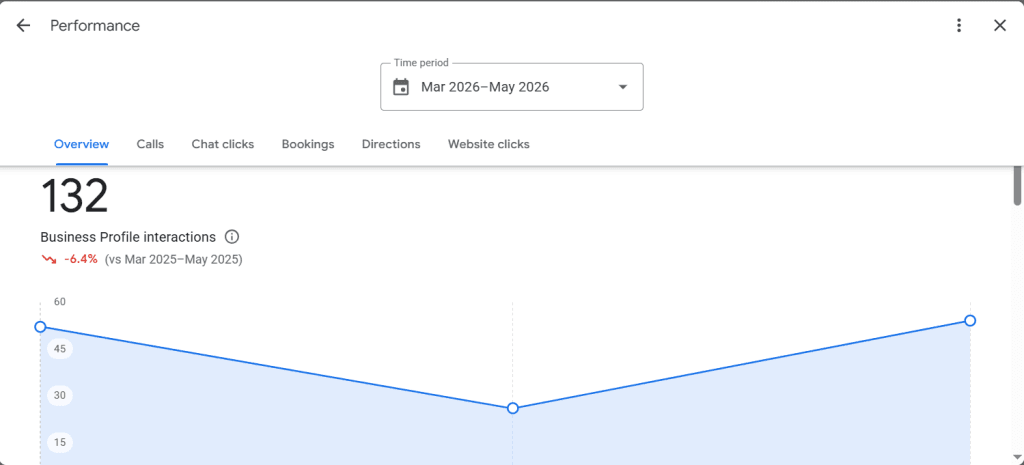
An adult education and continuing skills development center in Lonay, Canton de Vaud, Switzerland was experiencing a sustained and accelerating decline in Google Business Profile visibility during the critical spring enrollment window. The profile had been losing local search interactions through March and April 2026, hitting its lowest point in late April at precisely the moment prospective students in the French-speaking Vaud region needed to find and enroll. A 45-day GBP rescue sprint centered on native French-language optimization and profile localization stopped the decline immediately and drove May interactions sharply upward, completing a full V-shaped recovery and generating 132 total Business Profile interactions across the three-month tracked period, entirely through GBP-only work with no website access.
Result Snapshot
| Metric | Result Achieved |
|---|---|
| Tracking Period | March 2026 to May 2026 |
| Total GBP Interactions | 132 verified interactions |
| Interaction Pattern | V-shaped recovery: decline through March-April, sharp reversal in May |
| Lowest Point | Late April 2026 (exact point of intervention) |
| Sprint Duration | 45 days (end of April through mid-June) |
| YoY Comparison | -6.4% vs March to May 2025 |
| Recovery Confirmation | May interactions returned to March peak levels |
| Website Access | None — GBP-only intervention |
| Primary Optimization Approach | Native French-language localization for Canton de Vaud |
| Data Source | Google Business Profile Performance Dashboard |
About the Client: An Adult Education Center Serving French-Speaking Learners in Canton de Vaud
This client operates an adult education and continuing skills development center in Lonay, a municipality in the Canton de Vaud in the French-speaking region of western Switzerland, commonly known as Romandy. The center offers skill development courses, evening classes and continuing education programs for working adults looking to build professional competencies, reskill or pursue personal development. The institution serves students across the Vaud region, including the broader Lausanne catchment area and surrounding lakeside communes.
The adult education market in French-speaking Switzerland operates with specific linguistic and cultural characteristics that differ substantially from German or Italian-speaking Swiss regions and from international English-language education markets. Prospective students in Canton de Vaud search for courses using French-language terminology, evaluate institutions through a French-language lens and expect a local educational provider’s online presence to reflect the linguistic identity of the region. An adult education center in Lonay whose Google Business Profile does not speak natively to the French-speaking search audience is not simply underperforming. It is presenting itself as culturally misaligned to the very learners it exists to serve.
For an adult education center, the spring enrollment window is the most commercially sensitive period of the academic calendar. Courses beginning in May and June require students to find, evaluate and commit to a program in April. A profile losing visibility in March and April is losing students during the exact weeks when enrollment decisions are being made.
The Problem: A Visibility Freefall During the Most Critical Enrollment Window of the Year
The GBP performance data from March through April 2026 showed a clear and worsening decline. Interactions began at approximately 52 in March, dropped through April and reached their lowest recorded level in late April, at the exact point of intervention. For a continuing education center in Lonay, this timing was not merely inconvenient. It was a direct threat to the institution’s spring and summer enrollment cycle.
Prospective students in the Vaud region searching for evening courses, professional skills training or adult learning programs in April are not browsing without intent. They are evaluating institutions, comparing course offerings and making enrollment decisions. A profile that is declining in the local map pack during this window is systematically losing prospective students to competitors whose local presence is better optimized for the specific search behavior of French-speaking adults in Canton de Vaud.
The business had no website support available for this project, which meant every student who found the institution through Google was relying on the GBP profile to make their evaluation. The quality and relevance of that profile was the entire first impression for local search traffic. A declining profile was therefore not just a visibility problem. It was a direct point-of-contact problem with prospective students at the moment of their enrollment decision.
Root Cause Analysis: Why a Generic Profile Fails in a Linguistically Specific Market
The underlying cause of the visibility decline was a mismatch between how the GBP profile was presenting the institution and how French-speaking adults in Canton de Vaud actually search for adult education services.
The first and most significant issue was language specificity. Google’s local search algorithm for a French-speaking market in Switzerland responds to French-language relevance signals. When a prospective student in Lonay types “formation pour adultes” or “cours du soir Vaud,” the algorithm evaluates which profiles in the local pack have content that closely matches those specific French-language search terms. A profile with generic, non-localized descriptions, English-influenced terminology or category labels that do not reflect the French vocabulary of adult education in Romandy sends a weak relevance signal for these searches. Over time, as competitor profiles accumulate more locally relevant content, the algorithm adjusts its map pack selections accordingly, and the less locally optimized profile’s visibility declines.
The second issue was category imprecision. Adult education as a search category encompasses a wide range of institution types, from language schools to professional certification bodies to general continuing education centers. The specific categories selected on a GBP profile determine which local searches the profile is eligible to appear in. Categories that are too broad or that do not precisely match the specific type of adult learning the center offers place the profile in a wider competitive pool where it must rank against institutions that are not directly comparable and where its relevance for specific course searches is diluted.
The third issue was service data completeness. The Services section of the GBP profile was not fully updated to reflect the center’s current curriculum using the French-language course names and descriptions that local students would recognize and search for. When a profile’s service data does not match the search language of its audience, it misses the relevance matches for the specific course queries that represent highest enrollment intent.
The fourth issue was profile activity recency. Google’s algorithm weighs profile freshness as a relevance signal. An adult education center whose profile has not been updated with recent course information, enrollment dates or Google Posts signaling current academic activity presents a stale signal that contributes to declining map pack positioning over time.
The Strategy: Native French-Language Localization as the Core Rescue Mechanism
The strategic decision for the 45-day sprint was to center the entire intervention on native French-language localization of every profile element. This was not a general GBP optimization. It was a language-specific, culturally grounded restructuring designed to close the gap between how the profile was presenting the institution and how French-speaking adult learners in Canton de Vaud actually search for and evaluate educational programs.
The urgency of the timing shaped everything. With late April being the lowest interaction point and the spring enrollment window closing through May, the intervention needed to produce visible algorithmic response within weeks, not months. GBP content changes can begin influencing local search positioning within one to two weeks of publication. The 45-day contract was calibrated to the speed at which a focused, high-quality GBP localization can produce measurable interaction recovery, without relying on the slower mechanisms of website SEO, citation building or link acquisition.
No off-site work was included in the sprint. The entire intervention operated within the GBP ecosystem. This constraint was the project scope, and the strategy was built to extract maximum impact from profile-level changes within that constraint.
The Execution: 45 Days of French-Language Profile Reconstruction in Canton de Vaud
Week 1: Profile Audit and French-Language Search Behavior Mapping
The first phase of the sprint was a complete audit of the existing profile against the specific search behavior of prospective adult learners in Canton de Vaud. This required mapping the French-language search terms that people in Lonay and the surrounding Vaud region use when looking for adult education, evening courses and professional skills training.
The audit identified specific gaps between the profile’s existing content and the search vocabulary of the target audience. Key French-language adult education search terms including “formation pour adultes,” “cours du soir,” “formation continue,” “développement professionnel” and location-specific variations were absent from or underrepresented in the profile’s content. These were the precise terms that prospective students in Romandy were using and that the profile was failing to match.
Primary and secondary GBP categories were reviewed and restructured to precisely reflect the type of adult education institution this center is, using the category options that best match the specific French-speaking Swiss adult education search landscape.
Week 2 to 3: Business Description and Services Section Reconstruction in French
The business description was completely rewritten in native French, using the language, tone and terminology that a prospective adult learner in Canton de Vaud would find immediately recognizable and trustworthy. The description communicated the center’s mission, course scope and the specific learner profile it serves, in the voice of an institution that is genuinely part of the French-speaking Swiss educational community.
The Services section was rebuilt to accurately reflect the center’s current curriculum using French-language course names and descriptions matching actual local search queries. Each service entry was named and described using the terminology that students in Vaud use when searching for those courses, not the generic or anglicized alternatives that a non-localized profile might default to.
This reconstruction addressed the relevance match problem at its source. When a student in Lonay searches for “cours du soir” and the profile’s Services section contains a clearly named and described evening course offering using exactly that terminology, the algorithm has a precise relevance match to reward. Without that match, the profile competes only on proximity and general business type, which is insufficient in a market where other institutions are providing specific French-language relevance signals.
Week 3 to 5: Google Posts Campaign for Enrollment Season Visibility
A structured Google Posts campaign was developed and executed throughout the sprint, timed specifically to the spring enrollment window. Posts covered:
Upcoming course enrollment dates presented with the urgency and clarity relevant to adult learners balancing professional and personal commitments. Course highlights and outcomes presented in the language and framing most relevant to working adults in Canton de Vaud who are considering whether to commit time to a program. Institutional trust signals that reinforce the center’s reputation within the Vaud adult education community.
Every post was written entirely in French, using the register and vocabulary appropriate for the French-speaking Swiss professional and adult learner audience. A Google Post in a regional language market that defaults to English or to generic phrasing not only fails to connect with the target audience but sends a weaker algorithmic relevance signal than a post written specifically for the local search context.
The posting cadence was calibrated to produce a consistent freshness signal through the critical May enrollment period without diluting the quality of individual posts. For an adult education institution, the credibility of the published content directly reflects on the credibility of the institution itself.
Week 5 to 6: Visual Content and Final Profile Alignment
Visual content was reviewed and updated to reflect the center’s current course offerings and learning environment. For an adult education institution in Switzerland, the imagery associated with the profile contributes to the trust signal that prospective students assess when deciding whether to engage. Images that communicate a professional, structured and locally grounded learning environment align with the expectations of working adults in Canton de Vaud who are making a meaningful commitment of time and money to enroll in a program.
All profile elements were reviewed for consistency to ensure the French-language content across the business description, Services section, Google Posts and category configuration was presenting a unified, coherent entity to both the search algorithm and the prospective students finding the profile in local search.
The Results: V-Shaped Recovery Completed, Enrollment Season Saved
The GBP performance graph for March through May 2026 shows the outcome with precision. March began at approximately 52 interactions, declined through April to approximately 28 at the lowest point in late April, and then reversed immediately upon intervention. May delivered a sharp, uninterrupted upward recovery that brought interaction levels back to the March peak by the close of the month, completing the V-shape visible in the dashboard.
Total interactions across the three-month window reached 132, with the recovery in May accounting for the upward movement that offset the April trough. The year-over-year comparison shows -6.4% versus March to May 2025. This context is important to address directly. The three-month window captures both the pre-intervention decline in March and April and the post-intervention recovery in May. A period that includes two months of declining performance before a sprint begins will always carry a YoY deficit unless the recovery month is strong enough to overcome the prior months’ losses in the aggregate. The relevant comparison is not the three-month total against the prior year, but the May trajectory against April, which shows an unambiguous and complete recovery to peak performance levels.
For an adult education center in Lonay, the May recovery completed during the sprint corresponds directly with the spring enrollment period. Students who found the center through the restored local profile in May were searching during the weeks when course enrollment decisions are made. The profile’s return to peak visibility during those specific weeks is the outcome that carries the most commercial significance for the institution’s enrollment cycle.
Frequently Asked Questions About GBP Optimization for Adult Education Centers in French-Speaking Switzerland
Google’s local search algorithm for the French-speaking region of Switzerland evaluates relevance against the French-language search terms that prospective students in Canton de Vaud actually use. A profile with generic, non-localized or non-French content sends a weak relevance signal for searches like “formation pour adultes” or “cours du soir Vaud,” even if the institution offers exactly what the searcher needs. Native French-language content across the business description, Services section and Google Posts creates the precise language match that the algorithm rewards with map pack visibility.
The highest-intent search terms for adult education in French-speaking Switzerland include “formation pour adultes,” “cours du soir,” “formation continue,” “développement professionnel,” “cours de reconversion” and location-specific variations combining these terms with “Vaud,” “Lausanne,” “Lonay” or the specific commune where the institution is located. A GBP profile that incorporates these terms naturally across its profile content creates relevance matches for the full range of queries that prospective students in Romandy use when evaluating continuing education options.
This project demonstrates that it can within a 45-day timeframe, producing a complete V-shaped interaction recovery from a significant visibility decline. The GBP profile serves as the primary discovery interface for local searchers in Canton de Vaud who are actively looking for adult education programs. When the profile content is precisely aligned with French-language search behavior in the region, the algorithm responds to the improved relevance signal relatively quickly, typically within two to four weeks of optimized content being published and indexed.
Timing is critical. The spring enrollment window for adult education courses beginning in May and June requires prospective students to discover and evaluate institutions in March and April. A GBP that is declining in local search visibility during those months is losing prospective students at the peak of their enrollment decision-making. A sprint calibrated to the enrollment calendar, that restores visibility by the beginning of May, produces the maximum enrollment-season impact because the recovered local presence is active during the weeks when student decisions are made.
General GBP optimization addresses technical profile completeness, category configuration and basic content structure. French-language localization goes further, ensuring that every element of the profile, from the business description to individual service entries to Google Posts, uses the specific French-language terminology that adult learners in Canton de Vaud use when searching for courses. For a local educational institution in a linguistically specific market like Romandy, general optimization produces baseline competitiveness. Native French-language localization produces the search relevance match that drives actual interaction growth.
The interaction decline reflected a gradual erosion of the profile’s relevance match for French-language adult education searches in Vaud. Without active profile management, freshness signals decay, category configurations become outdated as search behavior evolves and the profile falls behind competitor profiles that are being actively maintained. Without a structured localization intervention, there is no mechanism for the relevance gap to close on its own. The profile’s visibility would have continued declining through the enrollment season without the 45-day sprint.
Switzerland’s multilingual character means that Google’s regional search algorithm adjusts its relevance assessment based on the dominant language of the searcher’s query and location. In Canton de Vaud, where the population is overwhelmingly French-speaking, the algorithm weights French-language relevance signals for local searches. A business profile in Lonay that presents primarily in another language, or in generic terms without French-language specificity, competes at a disadvantage against locally optimized French-language profiles. The principle is the same as any other localization requirement, but the specificity of linguistic identity in Switzerland’s regional markets makes it especially pronounced.
The most effective Google Posts for a continuing education center in French-speaking Switzerland during enrollment season are those that address the specific decision-making concerns of working adults: enrollment deadlines with clear dates, course outcomes framed in terms of professional benefit, schedule flexibility relevant to working adults balancing family and employment, and institutional trust signals that establish the center’s credibility within the Vaud educational community. Posts written entirely in French, using the register appropriate for professional adult learners rather than general consumer audiences, earn stronger engagement from the target audience and contribute a stronger French-language relevance signal to the profile’s algorithmic standing.
No. The -6.4% YoY figure compares the full March to May 2026 period, including two months of declining interactions before the intervention began, against the same period in 2025. A sprint hired at the lowest point of a three-month window will always produce a mixed YoY aggregate because the earlier months cannot be retroactively improved. The accurate measure of the intervention’s effectiveness is the May trajectory, which shows interactions returning to their March peak levels in a single month of recovery. The YoY metric will correct and likely improve as the profile maintains its optimized state through the equivalent period in 2026 without a pre-intervention decline weighing it down.
If you run an adult education center, language school or professional training institution in French-speaking Switzerland and your Google Business Profile is not generating the local interactions needed to support enrollment season, the gap between your profile’s current presentation and what prospective students in Romandy are searching for is usually identifiable and fixable within a focused sprint. Book a free video call or send a message on WhatsApp to review your profile together.