


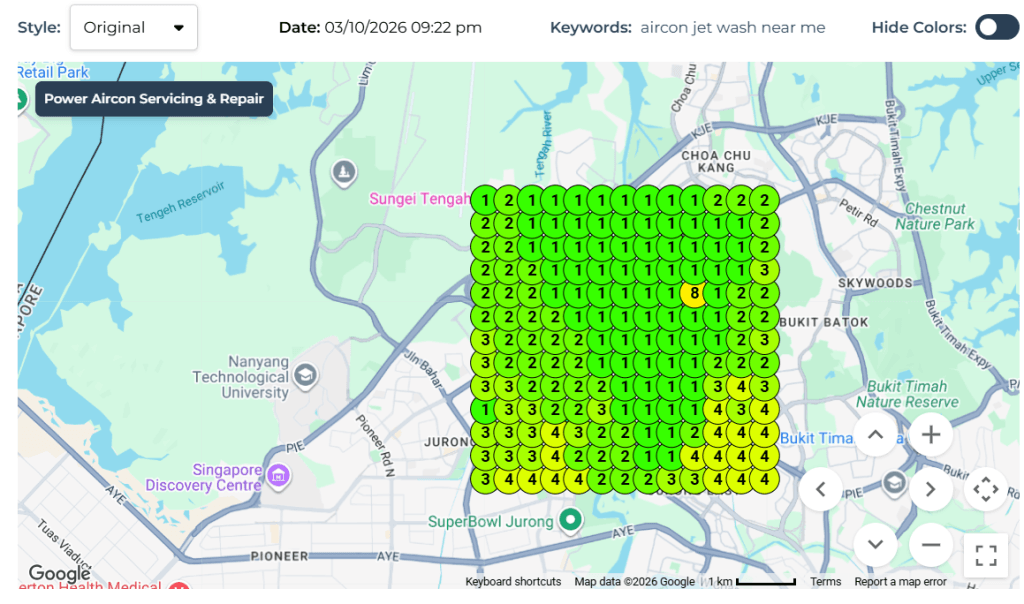
An aircon servicing and repair company in West Singapore was ranking in positions 10 to 20 for urgent, high-converting search terms like “emergency aircon repair near me” just a few blocks from their own address. A structured local SEO campaign combining dedicated website service pages with 1-to-1 GBP mapping broke the proximity filter and turned a 169-point geo-grid almost entirely green for “aircon jet wash near me,” capturing 88.17% of the Top 3 map pack market share across a 23.22 square kilometer service zone within two months.
Result Snapshot
| Metric | Result Achieved |
|---|---|
| Campaign Duration | 2 months (Q1 2026) |
| Geo-Grid Coverage | 169 grid points across 23.22 sq km |
| Keyword: aircon jet wash near me | Top 1-3 positions across near-entire grid |
| Top 3 Market Share (West Singapore zone) | 88.17% captured |
| Starting Position (emergency terms) | Positions 10 to 20+ across most of the grid |
| Tracking Tool | LeadSnap Geo-Grid and Ranking Reports |
| Core Strategy | Website-GBP 1-to-1 service intent mapping |
| Proximity Filter Status | Broken — visibility expanded to full neighborhood coverage |
About the Client: A Leading Aircon Service Provider in West Singapore’s High-Density Residential Belt
This client operates a well-established aircon servicing and repair business targeting the densely populated residential areas of West Singapore, covering neighborhoods across the Jurong, Bukit Batok, Bukit Timah and Sungei Tengah corridor. The business offers a full range of services including routine aircon servicing, jet wash cleaning, chemical overhaul and emergency repair for both residential and commercial units.
Singapore’s aircon servicing market is intensely competitive. Nearly every HDB estate and private residential cluster has multiple providers competing for the same high-intent local searches. For a business operating in West Singapore, ranking on the local map pack is not a supplementary channel. It is the primary way new customers find, evaluate and contact them. The difference between appearing in position 1 and position 8 in Singapore’s aircon repair map pack is, in practical terms, the difference between a phone that rings consistently and one that does not.
The Problem: Invisible for High-Intent Searches Just Minutes From Their Own Location
When the campaign began, the business had a functioning Google Business Profile and a website. On the surface, it looked like a local SEO foundation was in place. The problem revealed itself only when geo-grid data was run across their actual service territory.
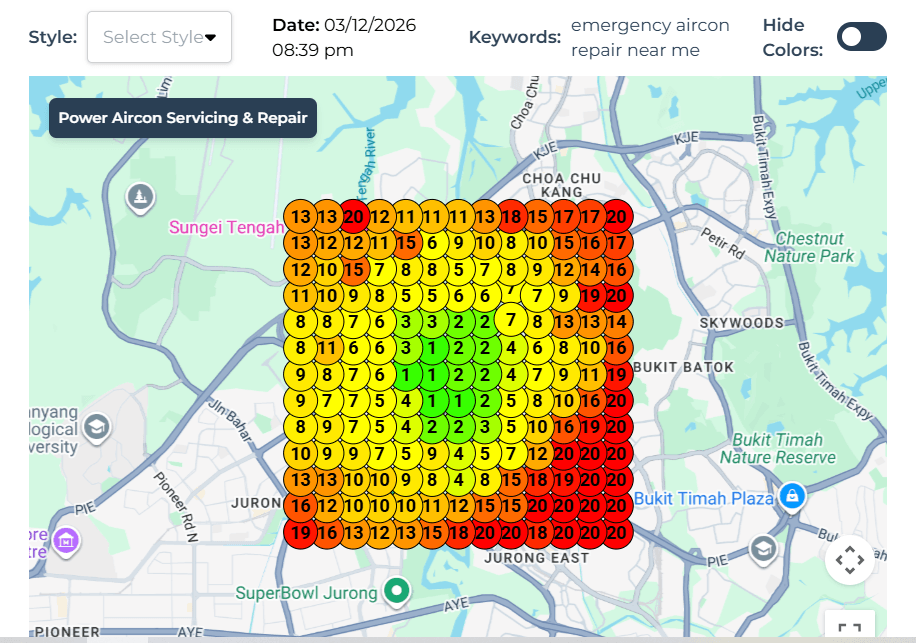
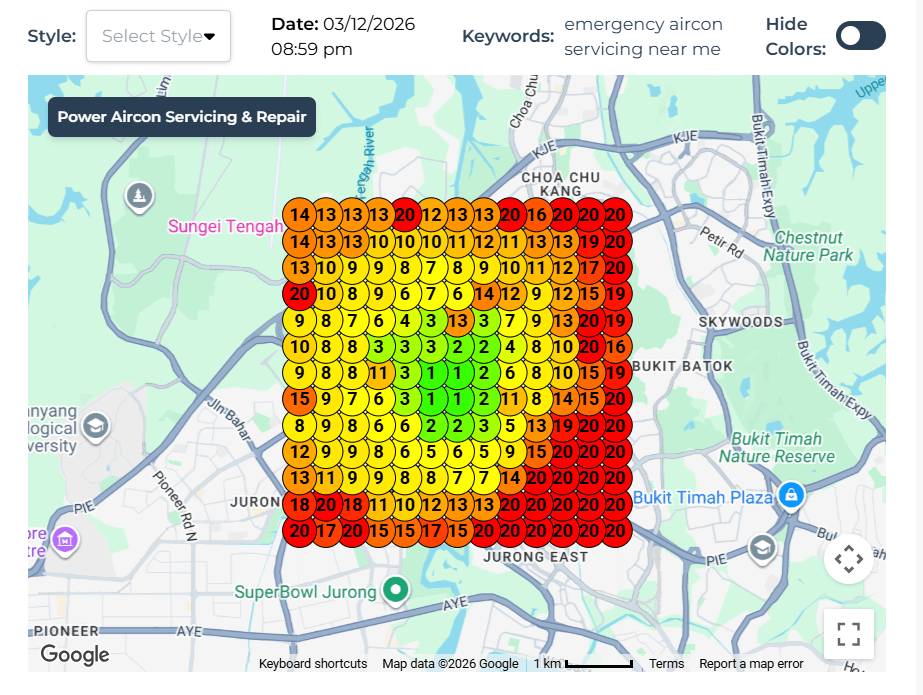
For generic terms, the profile was holding moderate positions in the immediate vicinity of the business address. But for the searches that actually drive revenue, specifically high-urgency terms like “emergency aircon repair near me” and “emergency aircon servicing near me,” the grid was almost entirely red and orange. Positions 10 through 20 dominated the map. In many grid points across Jurong East, Bukit Batok and surrounding neighborhoods, the business was not appearing in the top 20 at all.
For an aircon company in Singapore, emergency repair searches are among the most valuable queries in the entire business. A customer whose aircon unit fails in the middle of the night or on a weekend is not scrolling through page two of local results. They click the first visible business in the map pack. Losing those searches to competitors meant losing high-ticket, high-urgency jobs to businesses that had invested in their local SEO presence.
Root Cause Analysis: Why a Functioning Business Was Invisible Across Its Own Service Area
The geo-grid data pointed to a specific and diagnosable problem. This was not a case of a new or unestablished business failing to rank because it lacked authority. This was an established aircon servicing provider whose online presence was structured in a way that prevented Google from understanding the connection between its services, its location and the specific searches it should be appearing for.
The first issue was website architecture. The website had general service content but no pages dedicated to specific service intents. There was no standalone page for aircon jet wash as a distinct service. There was no page built around emergency aircon repair as a specific offering. Google’s local ranking algorithm uses relevance as one of its three core signals alongside distance and prominence. When a searcher types “emergency aircon repair near me,” Google looks for strong on-page signals confirming that a business specifically and explicitly offers emergency aircon repair, not just aircon services in general. A single catch-all services page does not send that signal with enough clarity.
The second issue was the disconnect between the website and the GBP Services section. Even when a business offers the right services, if those services are listed generically on the profile without detailed descriptions and without a direct connection to a corresponding web page, Google has no entity bridge to work with. The algorithm cannot confidently associate a specific service intent on the profile with a specific, authoritative page on the website. This weakens the relevance signal for that keyword cluster and prevents visibility from expanding beyond the immediate proximity of the business address.
The third issue was the proximity filter itself. Google’s local results naturally favor businesses closest to the searcher. Without strong relevance signals, a business can only overcome this filter for searches happening very close to its physical address. As soon as the searcher is in Bukit Batok rather than directly in front of the business, the ranking drops because there is no relevance signal strong enough to compensate for the distance. The red geo-grid was a direct visual representation of this mechanism in action.
The Strategy: Service-Intent Architecture Connecting Website and GBP as a Single Entity Signal
The strategic decision was to rebuild the connection between the website and the GBP profile by creating a one-to-one relationship between dedicated service pages and GBP service listings. Generic local SEO tactics, such as adding more citations, pushing for more reviews or tweaking title tags, would not have resolved a structural architecture problem. The fix had to address the root cause directly.
The approach had two components. First, create individual, dedicated website pages for each high-value service intent, written and structured specifically for that search query and that geographic context. Second, map each of those pages directly to a corresponding entry in the GBP Services section, with descriptions that reinforce the service-specific language and a direct link back to the dedicated page. Together, these two components create what functions as a closed-loop entity signal: Google sees a specific service named on the profile, follows the connection to a dedicated page built around exactly that service, and receives a consistent, reinforced relevance signal for that search intent.
This approach was chosen over a broader content or citation-building campaign because the data from the geo-grid was unambiguous. The business was not failing because it lacked reviews or citations. It was failing because Google could not confidently match its profile and website to the specific, high-intent queries that matter most in the Singapore aircon servicing market.
The Execution: How the Website-GBP Synergy Was Built Across Two Months
Phase 1: Geo-Grid Baseline and Architecture Audit (Week 1 to 2)
Before any changes were made, a full LeadSnap geo-grid baseline was run across a 13×13 grid covering the West Singapore service area. This established the exact position of the business for each target keyword at every grid point. The data confirmed what the business suspected anecdotally: for terms like “emergency aircon repair near me” and “emergency aircon servicing near me,” visibility collapsed to position 10 or worse across most of the grid, with large sections in the 15 to 20 range.
A concurrent audit of the website and GBP identified the following specific gaps:
- No dedicated page existed for aircon jet wash as a standalone service.
- No dedicated page existed for emergency aircon repair or emergency aircon servicing.
- The GBP Services section contained generic service names with minimal descriptions and no URL mapping to specific website pages.
- The website’s internal linking structure did not reinforce any specific service page as an authority signal for a high-intent term.
Phase 2: Dedicated Service Page Creation (Week 2 to 4)
Individual service pages were built for each high-priority search intent. Each page was structured to satisfy a specific search query for a West Singapore customer, not a broad generic visitor. The pages included:
- A dedicated aircon jet wash page targeting “aircon jet wash near me” with content specific to the West Singapore residential context, the types of units most commonly serviced in that area and what the jet wash process involves.
- A dedicated emergency aircon repair page targeting “emergency aircon repair near me” addressing urgency signals, availability and what a customer in Singapore’s high-rise estates can expect during an emergency call.
- A dedicated emergency aircon servicing page targeting “emergency aircon servicing near me” structured to address the distinct search intent behind servicing calls versus repair calls.
Each page was optimized with neighborhood-level geographic references to Jurong, Bukit Batok, Choa Chu Kang, Sungei Tengah and Bukit Timah, which are the actual residential areas within the geo-grid coverage zone. This grounded the pages in the specific territory the business serves rather than generic Singapore-level content.
Phase 3: GBP Services Restructure and 1-to-1 Page Mapping (Week 3 to 5)
With the dedicated pages in place, the GBP Services section was rebuilt to match. Each service entry was:
- Given a specific, intent-matched service name reflecting the actual search query.
- Written with a detailed description using language consistent with the corresponding website page.
- Linked directly back to the dedicated website page for that service.
This 1-to-1 mapping between each GBP service entry and its corresponding website page created the entity bridge that had previously been missing. Google could now follow a clear, consistent signal from the search query to the profile listing to the website page and back again. The three signals, profile relevance, page content and geographic specificity, were now aligned instead of fragmented.
One complication arose during the GBP restructure. Certain existing service categories on the profile were too broad to be updated cleanly without triggering a re-verification prompt from Google. This was resolved by carefully editing descriptions and URLs without removing and re-adding services in a way that would flag the profile for review. The extra caution added approximately one week to the GBP update phase but prevented any disruption to the profile’s standing during the campaign.
Phase 4: Geo-Grid Monitoring and Validation (Week 6 to 8)
Geo-grid scans were run at regular intervals through weeks six to eight to track how the map pack positions were moving across the 169 grid points. The pattern that emerged matched the expected behavior of a relevance-signal improvement: positions began moving in the grid points closest to the business address first, then expanded outward into adjacent neighborhoods as Google’s crawl cycle processed the new page structures and the GBP mapping updates.
By the final tracking date in early March 2026, the “aircon jet wash near me” grid had turned almost entirely green across the full 13×13 coverage area.
The Results: 88% Market Share and a Near-Green Grid Across West Singapore
The final geo-grid scan for “aircon jet wash near me” confirmed top 1-3 positions across the vast majority of the 169-point grid covering 23.22 square kilometers of West Singapore. The 88.17% Top 3 market share figure represents the proportion of grid points where the business appeared in positions 1, 2 or 3 out of all grid points tracked.
The result was not a narrow cluster of strong positions around the business address with a drop-off into the red a few blocks away. The green extended across Sungei Tengah, Choa Chu Kang, Bukit Batok and the Jurong corridor in a consistent pattern, which is what genuine proximity filter breakage looks like in practice. The grid had gone from a business that could only rank well for customers standing almost directly outside its door to one that was the most visible option for any resident across a substantial section of West Singapore.
For emergency terms, the grid remained more competitive given the higher difficulty of those keywords and the continued strength of established competitors. However, the positions improved measurably from the baseline, and the business entered the visible top 10 across a much larger portion of the grid than at the start of the campaign.
The honest context here is that breaking the proximity filter for the most competitive emergency keywords in Singapore’s aircon market requires sustained work beyond two months. The two-month campaign established the architecture and produced verified results for the jet wash keyword cluster. The emergency terms are on a longer trajectory that the structural work now makes achievable.
If your aircon servicing business is showing up well near your own location but disappearing across the rest of your service area, that is a structural problem with a clear fix. Send a message on WhatsApp or book a free video call and we can look at your geo-grid together.