


A mobile golf simulator rental business in Troy, MI had near-zero organic search visibility despite serving premium events across Metro Detroit. Through Google Business Profile restructuring, technical SEO fixes, dedicated city and event-category pages, and FAQ schema implementation, the business achieved 127% more search impressions and 70% more organic clicks in 90 days.
Result Snapshot
| Metric | Result Achieved |
|---|---|
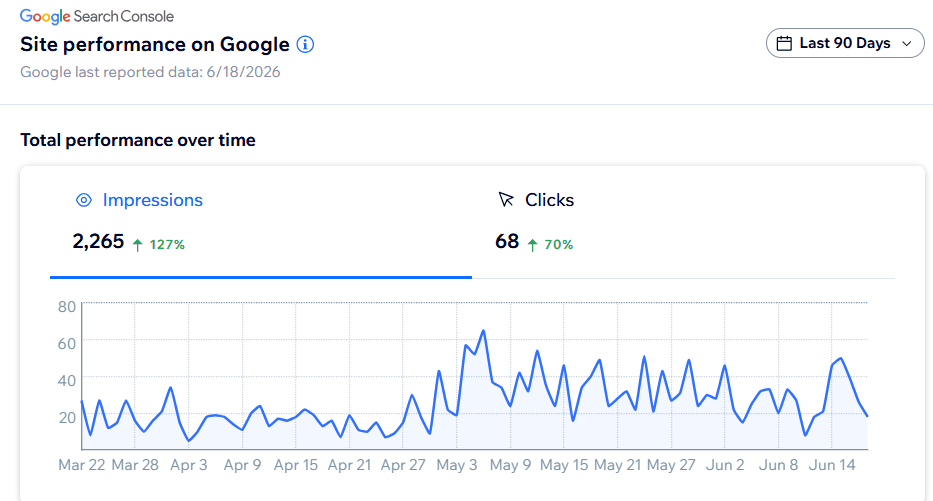
| Search Impressions (90-day period) | 2,265 total, 127% increase |
| Organic Clicks (90-day period) | 68 clicks, 70% increase |
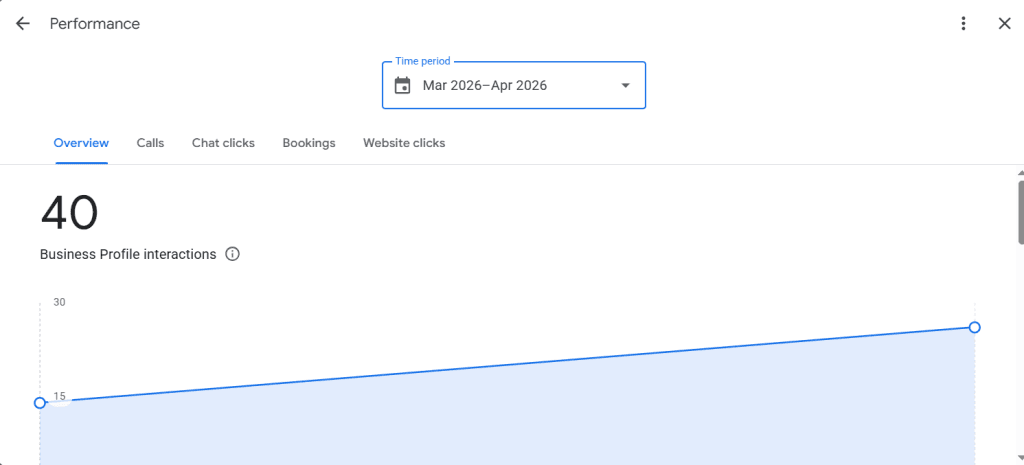
| GBP Interactions (March to April 2026) | 40 organic local interactions in initial rollout phase |
| Impression Spike Start Date | Early May 2026 |
| Engagement tracked | March 2026 to June 2026 |
| Data Sources | Google Search Console and GBP Dashboard |
About the Client: A Premium Mobile Entertainment Business Serving Troy and Metro Detroit
This is a mobile golf simulator and mini golf rental business operating across a wide footprint in Metro Detroit, Michigan. The business serves Troy as its primary base and extends coverage to surrounding communities including Livonia, Plymouth, Canton, Northville, Royal Oak, Rochester Hills, Berkley, Dearborn, Southgate and Wyandotte. There is no fixed public venue. The team delivers and installs professional-grade simulator equipment on-site at the client’s location, making the service available for corporate team-building events, holiday office parties, private birthday gatherings, weddings and backyard entertainment setups.
The customer segments are distinct and they search differently. Corporate HR and events teams booking group entertainment are one segment. Private hosts planning premium experiences for parties are another. Wedding planners and couples adding a high-engagement activity to receptions form a third. Each group searches with different phrasing, different intent and different timelines before committing. This diversity of buyer behavior is what makes the content architecture of a business like this unusually important for golf simulator party rental Metro Detroit searches compared to simpler single-service businesses.
The Problem: A Premium Service Invisible to the Searches That Drive Bookings
When the engagement started in March 2026, the business was producing almost no organic traffic from search. The Google Business Profile existed but was not generating meaningful map pack visibility. The website existed but was not ranking for any of the searches that translate into booking inquiries. Revenue was arriving through social media and direct word of mouth, both of which are useful but not scalable for a service priced at the premium end of the local entertainment market.
The damage was concentrated at the worst possible point in the buyer journey. A corporate events coordinator in Troy searching for a golf simulator rental for an upcoming team event was not finding this business. A couple in Royal Oak looking for mobile golf simulator rental for a wedding reception was not finding it either. Competitors with weaker setups but better-optimized profiles were appearing in those searches instead. Every week of low visibility during the spring event planning season represented real bookings that went to someone else.
Root Cause Analysis: Why a Miscategorized GBP and Flat Site Architecture Produce Near-Zero Search Visibility
How GBP Category Errors Systematically Hide a Business From the Right Searches
The Google Business Profile was live but miscategorized. The primary and secondary categories were set to generic entertainment or recreation tags rather than categories that reflect how people actually search when they are looking to book a simulator rental or mini golf rental for a specific event. Google’s local algorithm treats category selection as one of its strongest relevance inputs when deciding which profiles to surface for which searches. A profile in the wrong category is structurally invisible to the searches it should be competing for, regardless of review count, proximity or any other factor.
Beyond categories, the services section was underbuilt. It did not name specific rental packages, event types or coverage cities in language that matched search behavior. Images were uploaded but not geo-tagged, leaving a local relevance signal unused. These compounding gaps produced a profile that could not compete for corporate golf simulator rental Troy Michigan searches or any of the adjacent event-intent queries driving bookings.
Why a Flat Website Architecture Cannot Serve Multiple Cities and Event Types at the Same Time
The website’s structural failure was the absence of dedicated pages for specific rental intents and specific cities. Golf simulator rental for corporate events and mobile golf simulator rental for a birthday party in Livonia are different searches. They have different intent, different buyer timelines and different information needs. A single homepage or generic services page cannot rank competitively for both simultaneously.
Google’s local ranking algorithm rewards topical and geographic specificity. A page built specifically around “golf simulator rental for corporate team building in Troy, Michigan” sends clearer and stronger relevance signals than a homepage that mentions corporate events, parties and locations in general terms throughout a single page. Without dedicated pages, the site was asking Google to rank one broadly-written page for dozens of specific searches, and the algorithm declines that request consistently.
Technical indexing problems deepened the damage. Some pages were not being fully crawled, meaning the site was being ranked with less accessible content than it actually contained. FAQ schema was absent across the entire site, leaving the business ineligible for AI Overview appearances and featured snippet placements at a time when AI-generated search results are capturing an increasing share of zero-click searches. The H1 and H2 heading structure across existing pages was not aligned to actual keyword data, which meant the on-page relevance signals Google reads to understand page content were not communicating the right information about the service.
Why NAP Inconsistency Hurts a Mobile Multi-City Business More Than a Fixed-Location One
A mobile service with a service area rather than a single fixed storefront does not have the physical address anchor that Google can verify through street view, satellite imagery and cross-referenced reviews. For businesses like this, NAP consistency across external directories becomes one of the primary legitimacy signals Google uses to assign ranking confidence. Several directory listings carried outdated phone numbers and service area information from earlier versions of the business. This ambiguity was quietly suppressing local rankings across every city in the coverage footprint, not just Troy.
The Strategy: Two Channels Running in Parallel, Not Sequenced One After the Other
Two-Channel Attack: Map Pack Visibility for Immediate Booking Intent, Website for High-Consideration Event Searches
The decision was made to run GBP optimization and website restructuring simultaneously rather than completing one before starting the other. GBP optimization responds to category and completeness signals relatively quickly, typically producing local map pack visibility within four to six weeks. Website content indexing and ranking takes longer because Google needs time to crawl, assess and surface newly structured pages.
Sequencing these, waiting for GBP results before touching the website, would have cost six to eight weeks of compounding momentum. Running both in parallel meant the GBP could validate the strategy and capture immediate near-me booking-intent traffic while the website was being rebuilt for the longer-tail event searches that convert at higher ticket values. The GBP catches someone who already knows they want a golf simulator rental and is ready to call. The website catches a corporate event planner who is researching whether a golf simulator rental is the right option before deciding. Both audiences matter. Both channels needed to start at the same time.
Citation-only strategies were not treated as sufficient for this business. A mobile service covering Livonia, Plymouth, Canton, Northville, Royal Oak, Rochester Hills and eight other Metro Detroit communities needed its citation footprint to reflect the actual geographic coverage, not just list the business on national directories with no city-level specificity.
The Execution
Phase 1: GBP Category Overhaul and First Local Interactions (March 2026)
The first action was a full audit of the Google Business Profile alongside keyword research in Semrush to map real search behavior across the Troy and Metro Detroit area. Semrush identified which simulator rental and mini golf rental keywords were generating search volume and where competitor profiles had gaps in their category and services setup.
Based on this data, the GBP primary and secondary categories were replaced to precisely match simulator rental and event-based entertainment intent. The services section was rebuilt to name specific rental package types and the event formats each package serves. This specificity matters because Google reads the services section as a secondary relevance signal when matching profiles to searches.
High-quality images of actual event setups were uploaded with geo-tagging applied to the image metadata. Google reads location data embedded in image files as a local relevance signal. For a visual, high-ticket service like this, image quality also directly influences conversion at the profile level: a potential customer viewing the profile for the first time is deciding whether to click through or call based in large part on whether the images communicate the quality of what they would receive.
The outcome of this phase was 40 Business Profile interactions recorded across March and April 2026. These were organic, cold interactions from people who found the profile through local searches, not from existing contacts or paid promotion. That number validated that the category and optimization changes were producing map pack visibility for the right searches before any website work had begun to reflect in Google Search Console.
Phase 2: Technical SEO Audit and Site Architecture Rebuild (March to April 2026)
The technical audit identified the indexing issues quickly. Pages that should have appeared in search results were either absent from the index or indexed without enough on-page signal to compete for target searches. Crawl errors and structural blockers were addressed first to ensure that the new content being built would actually be processed by Google rather than sitting invisible.
The site architecture was then rebuilt around specific rental intents and specific city targets. Dedicated pages were created for each of the following:
- Corporate and holiday office event golf simulator rentals
- Wedding and private party golf simulator rentals
- Community, backyard and neighborhood event rentals
- Mobile golf simulator rental by city, covering Troy, Livonia, Plymouth, Canton, Northville, Royal Oak, Rochester Hills and all other service area cities
Each city page was built to rank for that city’s specific local modifier. Each event-category page was built to match the intent of someone planning that type of event. The architecture meant that a search for “golf simulator party rental Metro Detroit” or “corporate golf simulator rental Troy Michigan” landed on a page built specifically for that intent rather than a homepage that mentioned both in passing.
H1 and H2 tags across all key pages were rewritten using the Semrush keyword data. The heading structure was aligned to match how people actually search for this service, not how the business internally described what it offered.
FAQ schema was implemented across service pages and city pages. Mobile golf simulator rental generates a predictable set of specific questions: indoor versus outdoor setup requirements, available event types, group size capacity, rental duration options, delivery radius and lead time for booking. Marking up these questions and answers with FAQ schema signals to Google and to AI search engines including ChatGPT, Gemini and Google AI Overviews that the page contains structured, authoritative answers to exactly these queries. This improves eligibility for AI-generated search summaries and featured snippets without requiring the business to rank organically in position one.
Phase 3: Citation Building, NAP Correction and Geo-Grid Monitoring (April to May 2026)
A full NAP audit across existing directory listings revealed inconsistencies more significant than initially expected. Several platforms were carrying outdated phone numbers and service area information from an earlier version of the business. Some had the wrong business category. A few were missing city-level coverage information entirely.
Correcting these required direct outreach to individual platforms. Some directories processed corrections quickly through automated update systems. Others required manual review cycles that took two to three weeks to reflect the corrected information live. This delay is a realistic friction point in citation work that often goes unmentioned but has a real effect on the timeline for local ranking improvement. The citation correction delays pushed the expected full geo-grid expansion back by approximately two to three weeks compared to initial projections. The impact is visible in the GSC data: the strongest impression growth began in early May rather than late April as originally targeted.
New citations were built on top-tier general directories and on niche-relevant event planning and entertainment vendor platforms where the target audience actively searches when sourcing event services. The geographic specificity of each citation was matched to the actual service area, reinforcing city-level signals for Troy, Livonia, Plymouth, Canton, Northville, Royal Oak, Rochester Hills and the other service cities rather than anchoring everything to a single location.
Local Dominator geo-grid tracking was configured across the coverage area to monitor map pack ranking positions at a granular geographic level. A geo-grid shows not just whether a business ranks for a target keyword but exactly where across the service area the business appears in the map pack and where its visibility drops off. For a mobile golf simulator rental business covering over ten Metro Detroit cities, this turned ranking monitoring into an actual coverage map. Cities with strong local signal were identified. Cities where visibility was weak were flagged for additional citation or content reinforcement.
Phase 4: Content Indexing and the May Inflection Point (May to June 2026)
By early May, the restructured city pages and event-category pages had been fully crawled and were beginning to rank. This is the moment clearly visible in the GSC data. The 127% impressions increase was not spread evenly across the 90-day period. The data shows a sharp upward inflection starting in early May, which aligns precisely with when the newly indexed location and event pages began appearing in search results.
As more pages moved from newly indexed to actively ranking, impressions continued to grow through May and into June. Pages that had previously been blocked by technical issues were now live, indexed and sending relevance signals. The FAQ schema implementations were beginning to generate AI Overview eligibility for question-based searches. The combination of technical corrections, architectural specificity and schema markup was compounding.
The 68 organic clicks over the full 90-day period represent intent-driven traffic from people actively searching for a mobile golf simulator rental in Metro Detroit. For a service where a single corporate event booking can represent several times the monthly investment in SEO in a single transaction, each qualified click carries significant revenue weight. The volume is not high by general traffic standards. By the standards of a high-ticket, low-frequency local event service, it is exactly the right kind of traffic.
The Results: 127% More Impressions, 70% More Clicks and What the Data Actually Reflects
The 90-day period from March to June 2026 produced two distinct result streams that confirmed the dual-channel approach was correct.
The GBP optimization delivered fast local signal. Forty organic Business Profile interactions in March and April provided early proof that the map pack strategy was working for booking-intent searches before the website work had started to reflect in search rankings. These early interactions represented the highest-intent audience: people who already knew what they wanted and were searching for a provider.
The website delivered the larger compounding result. Impressions grew 127% to reach 2,265 over the period. Organic clicks grew 70% to 68. The growth pattern was not linear. March and April were foundational months where technical issues were resolved and new content was being built and indexed. The visible acceleration began in early May and continued through June, which is the natural timing for how Google processes and surfaces newly restructured content once technical barriers are removed.
One honest context note: the citation correction delays in April extended the expected geo-grid expansion by two to three weeks. That timing gap is why the strongest impression growth appears in May rather than late April. The correction work produced results, but platform processing delays on several directories were a real constraint. This is worth naming because it reflects what local SEO actually looks like when you are correcting legacy data problems rather than starting a profile from scratch.
The GBP and website channels served different buyers throughout. The GBP captured immediate near-me booking intent. The website captured higher-consideration research from corporate planners, wedding organizers and party hosts who were comparing options before committing. For a premium service like mobile golf simulator rental in Metro Detroit, both traffic types are necessary and neither alone is sufficient.
Ready to Find Out Where Your Business Is Losing Local Search Visibility?
If your local service business is generating too few bookings from organic search, book a free video call and I will walk through exactly where the gap is in your current setup. You can also message directly on WhatsApp for a faster response.