

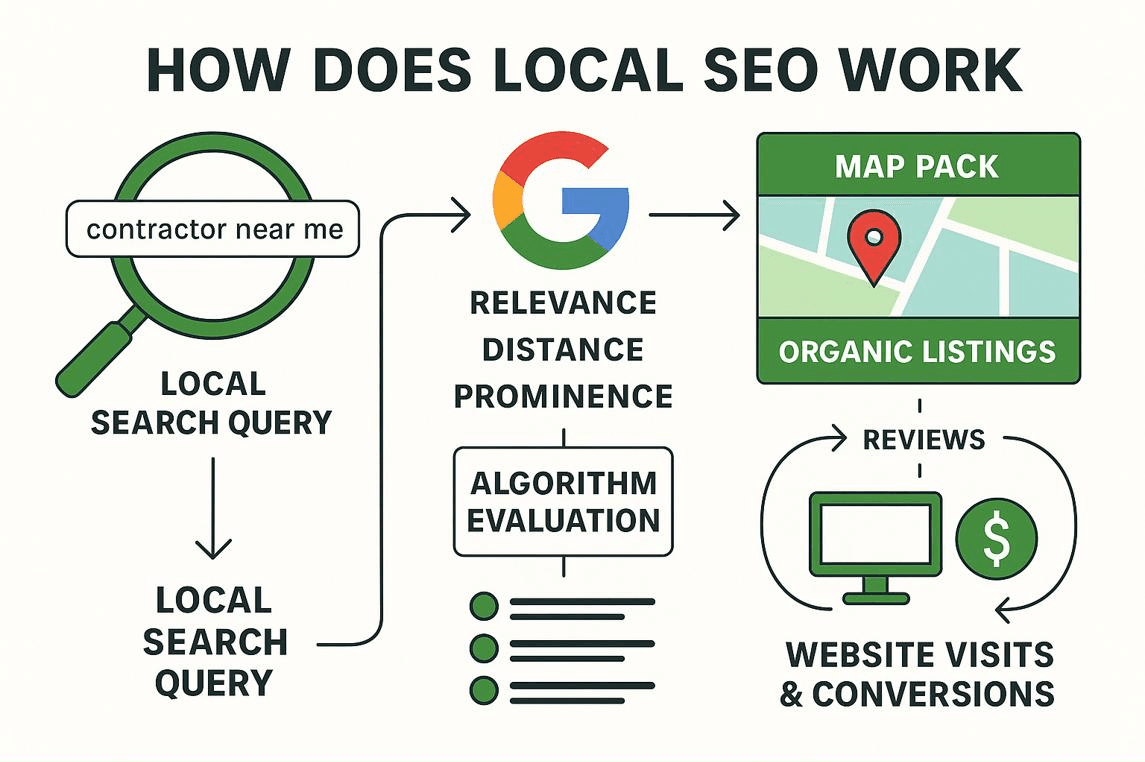

Local SEO is important because it determines whether your business or a competitor appears when someone nearby searches for what you sell. Without it, 46% of Google searches – all carrying local intent – bypass your listing entirely. This post explains why local SEO is important in 2026, what it costs to ignore, how AI search has raised the stakes, and where to start.
A plumber in Manchester runs a tight operation. Three vans, two apprentices, honest reviews from satisfied customers, and rates that are fair without cutting corners. He does good work. Enough good work that he assumed people would find him. So he built a website three years ago, set it and forgot it, and went back to doing what he does best.
His competitor two postcodes over does the same work. Not better. Not cheaper. But that competitor appears in the Google Map Pack every time someone in the area searches “plumber near me” or “emergency boiler repair Manchester.” That competitor’s phone rings. Our plumber’s doesn’t – or at least not enough.
The structural problem is not quality. It is not price. It is visibility at the exact moment a potential customer is ready to spend money. Local SEO is the discipline that closes that gap. It is the reason some businesses appear when intent is highest, and others do not – regardless of how good they actually are.
This post explains precisely why local SEO is important in 2026, what a business loses every day without it, how the rise of AI search has changed the game, and what both business owners and SEO freelancers need to understand before taking any next step.
What Local SEO Actually Is – and What It Is Not
Local SEO is the practice of optimizing a business’s online presence so it appears prominently in search results for location-based queries – on Google Search, Google Maps, and increasingly on AI-powered search platforms like ChatGPT and Google AI Overviews. It is not simply “being on Google.” It is structured, signal-based work that tells Google’s algorithm where a business operates, what it offers, who it serves, and why it should rank above every other business in the same area offering the same service.
Where general SEO competes at a national or global level, local SEO targets the geographic radius where customers are actually searching. A roofer in Calgary does not need to outrank a roofer in Phoenix. He needs to be the first result a homeowner in his suburb sees when they search after a storm. That specificity is what makes local SEO both more achievable for a local business and more directly connected to revenue than most other marketing channels.
What local SEO is not: it is not buying fake reviews, not bulk directory submissions without accuracy checks, and not running Google Ads and calling it optimization. The businesses that confuse paid traffic with organic local authority consistently underperform the moment their ad budget pauses – because they have built nothing that lasts.
Why 46% of Google Searches Matter to Your Business Right Now
Nearly half of all Google searches carry local intent – meaning the person searching is looking for a business, service, or product in a specific geographic area. That figure, 46%, represents an enormous share of daily search volume, and every one of those searches ends with someone either finding a business or not.
The behavior pattern behind this is well-documented. “Near me” searches have grown by over 500% in five years. Mobile search has made location-based queries the default – someone who needs a locksmith right now does not type brand names. They type “locksmith open now near me.” The business that appears at the top of that result gets the call. Businesses on page two might as well not exist.
What most content on this topic fails to explain clearly is the conversion rate attached to this traffic. Local search visitors are not browsing. They are in-market. They have a problem that needs solving today. When I work through BrightLocal data on local business audits, the same pattern appears consistently: local search leads convert at dramatically higher rates than traffic from general content or social media, precisely because the intent is active and immediate, not passive. A user who searched “emergency dentist near me” is not comparing dentists the way they might comparison-shop for a new laptop. They need an appointment. Now.
The 46% figure also means that any business ignoring local SEO is not simply missing a marketing channel. It is missing almost half of all Google’s search traffic that is directly relevant to its existence.
Why Local SEO Is Important for Google Maps and the Map Pack
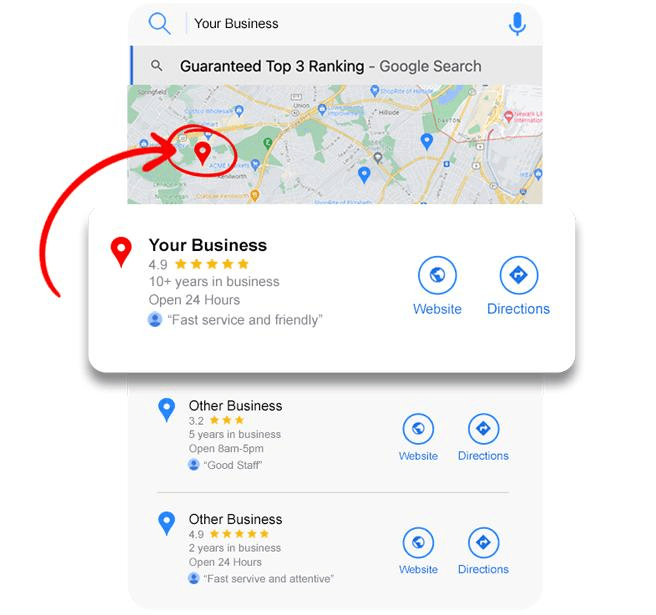
Google’s Map Pack – the block of three businesses that appears at the top of local search results with a pinned map – is the single most valuable piece of real estate in local search. Appearing in the Map Pack means your business is visible before any other organic result, before paid ads in many queries, and before any competitor who did not make it into those three positions.
The Map Pack is not random. Three primary local search ranking factors determine who appears: proximity of the business to the searcher, relevance of the business to the query, and prominence — how well-established and trusted the business is in Google’s data. These are not vague abstractions. They are the result of specific, optimizable signals: a fully completed Google Business Profile, consistent NAP information across the web, a strong local citation profile, positive and recent reviews, and locally relevant content on the business’s website.
For a local business, strong local business ranking on Google and Maps is not a bonus outcome of good marketing – it is the primary battleground. If three plumbers appear in the Map Pack for “emergency plumber in Cork” and a fourth plumber is not in that group, the fourth plumber does not exist in the decision-making process of anyone who searched that term. According to BrightLocal research, the Map Pack captures roughly 44% of clicks on local search results pages. Those clicks go to three businesses — not four, not five. Local business visibility in that top three is where most local revenue from organic search originates.
Google Business Profile: The New Homepage for Local Businesses
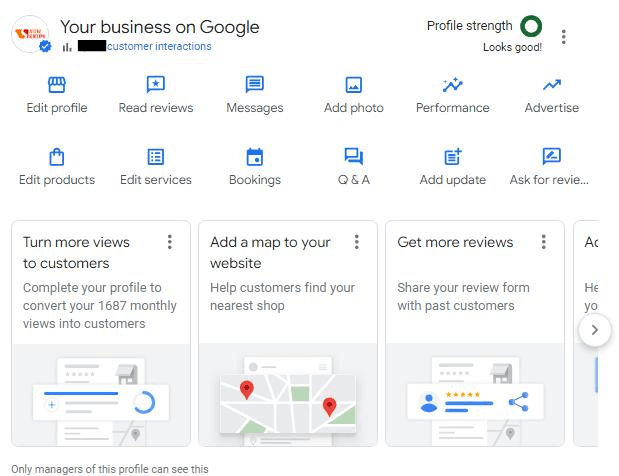
A fully optimized Google Business Profile is the most important single asset a local business controls for local visibility. It is not an afterthought to a website – in many local searches, the GBP is the first, and sometimes only, touchpoint a potential customer has with a business before they call, visit, or book.
Google Business Profile determines how a business appears across Google Search and Google Maps: the name, category, address, hours, services, photos, reviews, and Q&A that appear before anyone clicks through to a website. When I audit a Google Business Profile for a local tradesperson, the most common issues are missing or wrong primary categories, no service descriptions, photos that have not been updated in 90 days, and unanswered Q&A sections. Every one of those gaps is a signal Google cannot read – and a signal a competitor with a complete profile is sending instead.
Beyond ranking, a complete GBP converts better. A business profile with recent photos receives significantly more requests for directions than a profile with outdated or no visuals. A profile with responses to reviews signals to potential customers that the business is active and accountable. In 2026, Google Business Profile optimization also feeds AI Overview summaries – meaning what is in the profile directly influences how Google’s AI represents the business in generated responses at the top of search results pages. A profile that is incomplete or inaccurate now hurts visibility in both traditional search and AI search simultaneously.
AI Search Has Changed Who Gets Found in 2026
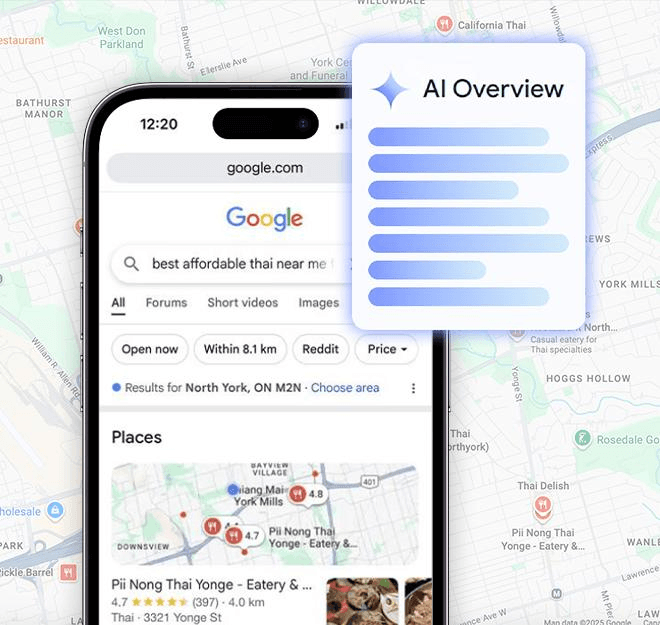
AI-powered search has fundamentally changed local business visibility in ways most local businesses have not yet registered. Google AI Overviews, ChatGPT, Gemini, and Perplexity now generate direct answers to local queries – and they recommend specific businesses by name.
When someone asks ChatGPT “who is the best HVAC company in Austin” or prompts Google’s AI Overview with “which pest control service near me has the best reviews,” the AI generates a response that surfaces specific businesses. The businesses it surfaces are not chosen randomly. They are selected based on structured data signals, review quality, entity consistency across the web, and the depth of their online content – the same signals that local SEO builds over time.
In 2026, a business with weak local SEO does not just miss organic rankings. It misses being named in AI-generated recommendations that a growing share of searchers never look past. A complete local SEO strategy in 2026 must include optimization for AI search platforms – not as an optional add-on, but as a core component of what determines local visibility. Businesses that built strong entity signals, consistent NAP data, and structured content before AI search went mainstream are now benefiting from both traditional rankings and AI-generated mentions. Those that have not are invisible in a channel their competitors may already occupy.
The 12-Month Cost of Ignoring Local SEO
The cost of ignoring local SEO is not theoretical. It is measurable, and it compounds every month.
A local business that is not appearing in the Map Pack or top local organic results is losing a specific, calculable number of potential customers every day. If the primary keyword for a roofing company in Dublin receives 400 local searches per month, and the Map Pack captures roughly 44% of clicks, those three businesses in the Pack share approximately 176 potential customer contacts every month. A roofer outside the Pack receives none of them from that search term.
Over 12 months, that is more than 2,100 missed contact opportunities from a single keyword. A roofing job in Dublin averages between €3,000 and €6,000. At even a conservative conversion rate, the revenue flowing to competitors from a single unranked keyword represents a significant annual loss – and that is before accounting for the multiple keywords a well-optimized competitor would be capturing simultaneously.
The compounding element is what makes delay expensive beyond the immediate revenue loss. Local SEO results take time to build – typically 60 to 90 days for meaningful Map Pack movement and 3 to 6 months for sustained first-page rankings. A business that starts today will see results in Q4. A business that waits until Q3 will see results in early next year, while a competitor’s authority grows uncontested in the meantime.
There is also a review velocity problem. Reviews accumulate over time. A competitor who started local SEO 12 months ago has a review base and a citation profile that cannot be closed overnight. Every month of inaction widens that gap in a direction that is slow and costly to reverse.
Local SEO vs. Paid Ads: What Makes More Sense for Local Business
Local SEO and Google Ads are not the same investment, and the confusion between them costs local businesses money in both directions.
Google Ads for local businesses generates immediate visibility at the top of search results — but only while the budget runs. The moment the campaign pauses, the visibility disappears. There is no residual value. A business that spends €1,500 per month on Google Ads for 12 months and then stops has nothing structural to show for that €18,000 in terms of lasting search presence. The moment the card stops, the calls stop.
Local SEO builds structural authority. A fully optimized GBP, a strong citation profile, and a website with solid local on-page SEO continue to generate visibility and leads after the initial work is complete. The investment compounds rather than evaporating when payment stops. To understand what that investment looks like in terms of specific deliverables and scope, local SEO pricing gives a practical frame for comparing it against what a business currently spends on ads.
This does not mean paid ads have no place in a local business’s strategy. For a newly launched business that needs calls within 30 days, paid ads fill the gap while local SEO builds. But for any business operating beyond its first six months that is not investing in local SEO, relying exclusively on paid traffic is an expensive substitute for something that would cost less, last longer, and generate compounding returns. For a dental clinic, a law firm, or an HVAC company with consistent recurring demand in their service area, local SEO is the higher-ROI channel for sustained customer acquisition.
For SEO Freelancers: Why This Is the Most Sellable Service Right Now
If you are building a freelance SEO practice, local SEO is where the case makes itself. Every local business owner you speak to either already knows they are not ranking and cannot explain why, or has no idea that their competitors are capturing their potential customers online every single day.
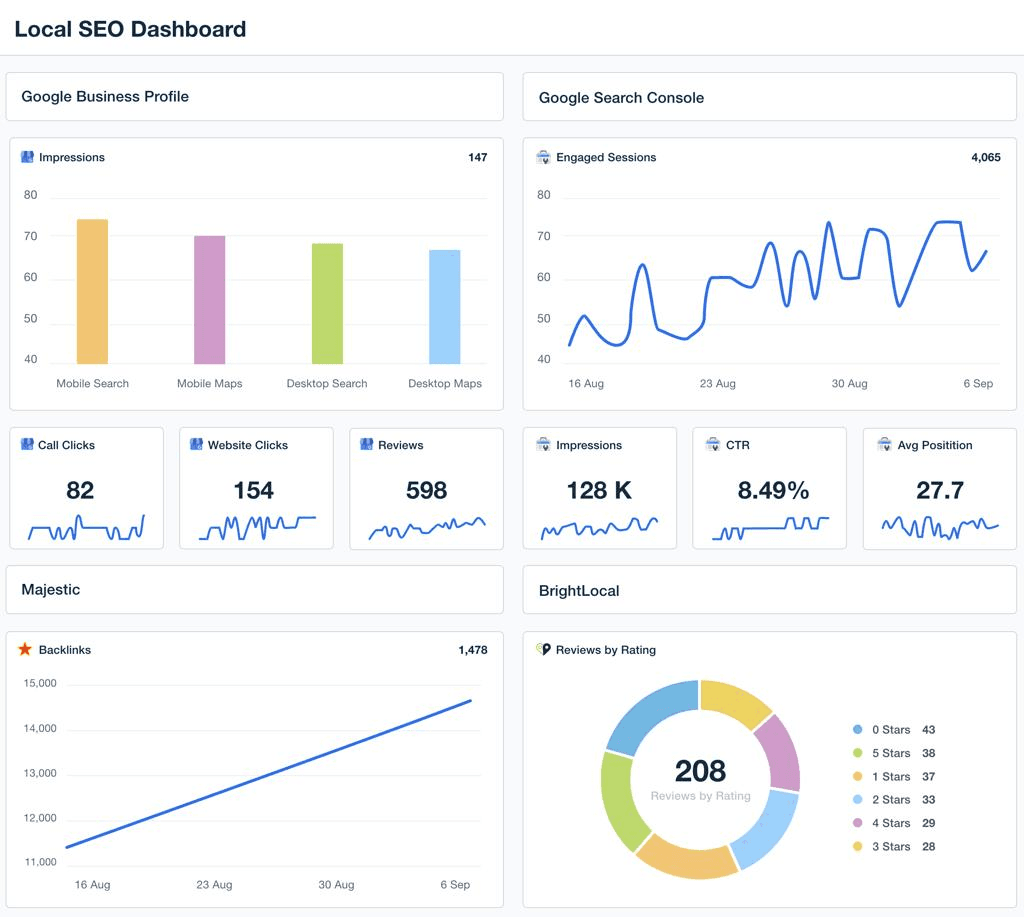
Local SEO is the most sellable SEO service because the results are visible, measurable, and tied directly to outcomes the client already cares about: phone calls, walk-ins, and bookings. Ranking a plumber in the Map Pack for “emergency plumber near me” does not require explaining domain authority or crawl budgets. The client understands the Map Pack. They use it themselves when they need a restaurant or a garage. The gap between where they are and where they need to be is something you can show in five minutes using BrightLocal or a simple Google search of their main keyword.
The entry point for the client conversation is the visible gap. When you pull a GBP audit for a prospect and show them that their listing has wrong or missing categories, no recent photos, and zero responses to reviews while their competitor has 80-plus reviews, posts twice a week, and Q&A filled out – that is a conversation that closes. The problem is tangible. The solution is specific. The outcome is directly connected to revenue the client already understands they are losing.
In 2026, the freelancers gaining traction fastest in local SEO are those who position around a specific service vertical – plumbers, dentists, roofers, cleaners – and go deep rather than offering generic SEO to anyone who will listen. Vertical specialization makes audits faster, proposals sharper, and case studies more transferable to the next prospect in the same niche. A freelancer who has ranked three plumbers in the Map Pack does not need to pitch a fourth plumber – the proof does the pitching.
The First Three Things to Fix Before Anything Else
For a local business that is not ranking, the correct sequence matters. Not every local SEO problem is identical, but the most common bottlenecks appear in a predictable order.
The Google Business Profile is incomplete or miscategorized
This is the starting point in almost every audit. A plumber with “Contractor” as their primary GBP category instead of “Plumber” is sending the wrong relevance signal to Google. A profile missing service descriptions, attributes, and recent photos gives Google less usable data than a competitor’s complete profile – and Google defaults to ranking the more complete, more clearly relevant listing. Fixing the GBP – selecting the right primary and secondary categories, writing service descriptions, uploading fresh photos, and filling out the Q&A section – is often the single fastest lever for Map Pack improvement.
NAP inconsistency across the web
Name, Address, and Phone Number must match exactly across the business’s website, GBP, Yelp, Bing Places, Apple Maps, and every relevant directory. A business that moved locations two years ago and never updated its Yelp or Foursquare listing has a trust signal problem Google can detect and acts on by suppressing rankings. NAP inconsistency is one of the top culprits when a business has flat rankings despite what looks like a decent GBP on the surface.
No local content on the website
A website that says “we serve the whole region” without a single page targeting a specific city or suburb is invisible for geo-modified searches. A plumber in Edinburgh who has no content mentioning Edinburgh – no service area pages, no city-specific landing pages, no locally relevant content – cannot rank for “plumber Edinburgh” because the geographic signal simply is not there for Google to act on. Every city or suburb a business wants to rank in needs a dedicated content signal pointing there.
Fix these three in sequence before investing in anything more advanced. Local link building, GEO optimization, and AI search visibility build on top of these foundations – they do not substitute for them.
What Happens in the Next 90 Days If Nothing Changes
This is where the decision becomes concrete.
In the next 90 days, local businesses investing in local SEO right now will see their citation profiles strengthened, their GBP authority grow, and their Map Pack appearances increase for core local keywords. Some will begin appearing in Google AI Overviews – meaning their business name starts showing up in AI-generated answers for local queries, a placement that did not exist as a meaningful competitive factor even two years ago.
For a business that does nothing in that same 90 days, the gap does not stay the same. It widens. The competitor who started three months ago now has 90 more days of review accumulation, citation authority, and content signals working for them. The window to close that gap narrows with every month of inaction – not because local SEO becomes more difficult, but because a competitor’s head start becomes a larger advantage to overcome.
Local SEO is not a one-time fix and it is not a speculative investment. It is the mechanism by which a business earns the right to be visible when a customer’s intent is highest – the exact moment they are searching, deciding, and ready to call. Businesses that control that moment control their own customer acquisition. Businesses that do not hand it to whoever in their area made the decision first.
The 90-day frame is not a threat – it is a realistic description of how compounding works in local search. Every day of optimized presence adds to an authority score that builds. Every day of absence lets that score belong to someone else.
Key Takeaways
- 46% of all Google searches carry local intent. Nearly half of everyone searching on Google right now is looking for a business near them. If your business is not optimized for local search, you are invisible to all of them, not some of them.
- The Google Map Pack captures roughly 44% of all clicks on local search results pages – and only three businesses appear in it. If your business is not one of those three, it does not exist in the decision-making process of the searcher who sees it.
- Google Business Profile is the most important single asset for local ranking. An incomplete, miscategorized, or inactive GBP is the primary reason most local businesses fail to appear in competitive local results – and it is the first thing to fix.
- AI search platforms now recommend specific businesses by name. ChatGPT, Google AI Overviews, Gemini, and Perplexity surface local businesses in AI-generated responses. Local SEO is what determines whether your business is named or completely absent from those recommendations.
- NAP inconsistency – mismatched Name, Address, and Phone Number across directories – is one of the most common and most damaging technical issues in local SEO. It is also one of the most straightforward to resolve once identified.
- The cost of ignoring local SEO compounds monthly. A competitor who started local SEO six months ago now has review velocity, citation authority, and content signals that take real time to close. Delay is not neutral – it is a widening gap.
- For SEO freelancers, local SEO is the most immediately sellable service because the gap between a prospect’s current visibility and their competitor’s is often demonstrable in five minutes. The problem is visible. The outcome is tied directly to revenue the client already understands they are losing.
FAQ
What is local SEO and why does it matter for a local business?
How long does it take for local SEO to show results?
Can a small local business rank above large national brands using local SEO?
What is Google Business Profile and why is it the most important factor in local SEO?
Does local SEO work for service area businesses that do not have a physical storefront?
How is local SEO different from regular SEO?
What happens to local rankings after a Google algorithm update?
Book a free video meeting and find out exactly why your business is not showing up — and what it will take to change it.